AI NativeLeader

Issue 03 · Posts

The Firm That Remembers.

The 9 short posts threaded into this issue — the atoms behind the weekly read. Read the full issue →

AI-Native LeaderThe Old Operating System

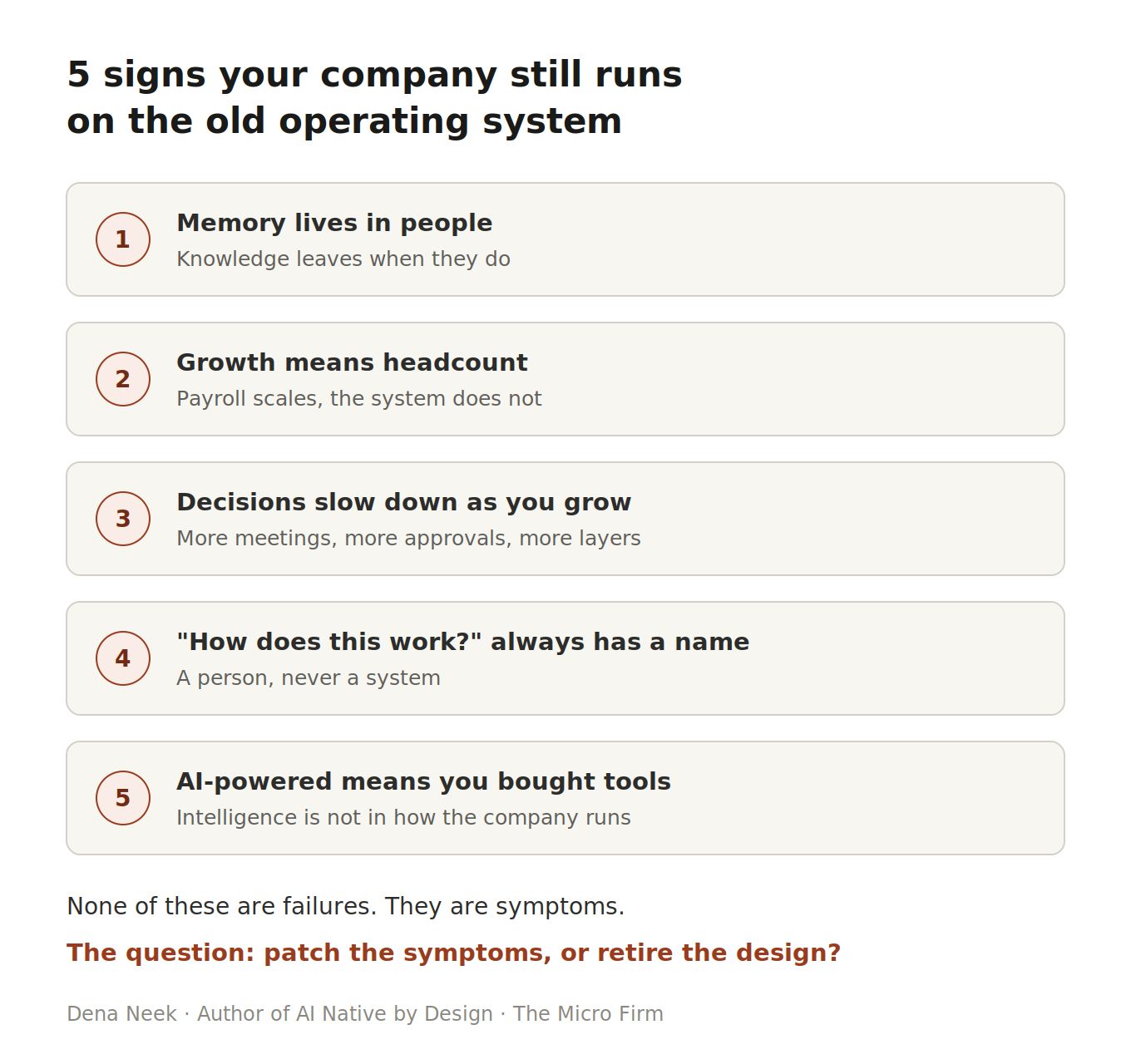
🚨 5 signs your company still runs on the old operating system:

1️⃣ Memory lives in people. When a key person leaves, the company forgets. Institutional knowledge was never institutional. It was personal.

2️⃣ Growth means headcount. More customers, more hires. The payroll scales. The system does not.

3️⃣ Decisions slow down as you grow. More meetings, more approvals, more layers. Coordination starts consuming the speed it was built to create.

4️⃣ "How does this work?" always has a name attached. Never a system. Never a document anyone trusts. If the answer is a person, you don't have an operating model. You have dependencies.

5️⃣ You call yourself AI-powered because you bought tools. Not because intelligence lives in how the company remembers, routes, and acts.

None of these are failures. They are symptoms.

The pyramid was designed for a world where humans were the coordination layer. This is what that design looks like at its limits.

Most companies have these symptoms. That part is not interesting. The interesting question is whether you treat them as problems to patch, or as a design to retire.
5 signs your company still runs on the old operating system
AI-Native LeaderAssisted vs Native

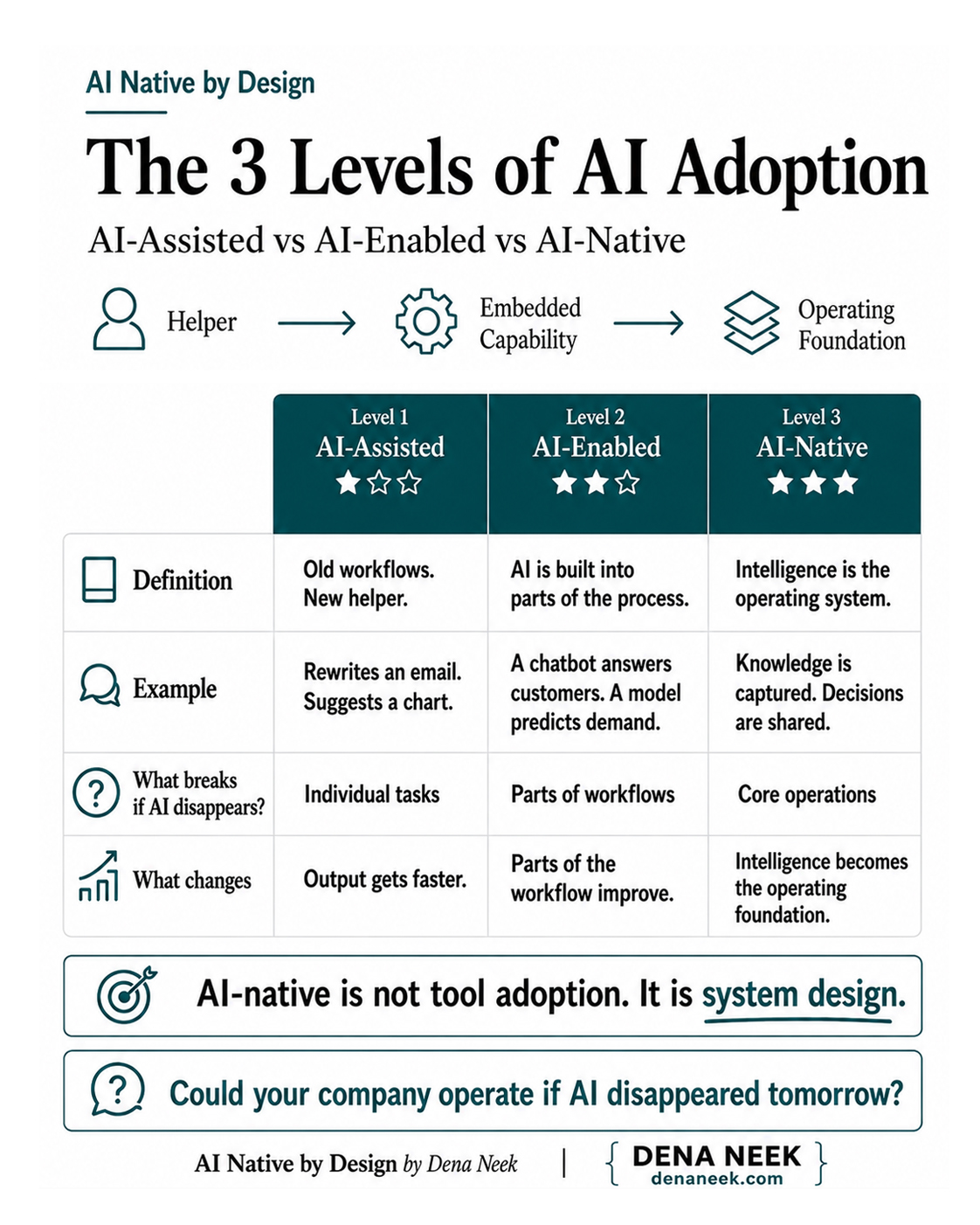
You bought the tools. Your team tried the prompts. A few workflows got faster. But the business still runs the same way.

That is the difference between using AI and becoming AI-native.

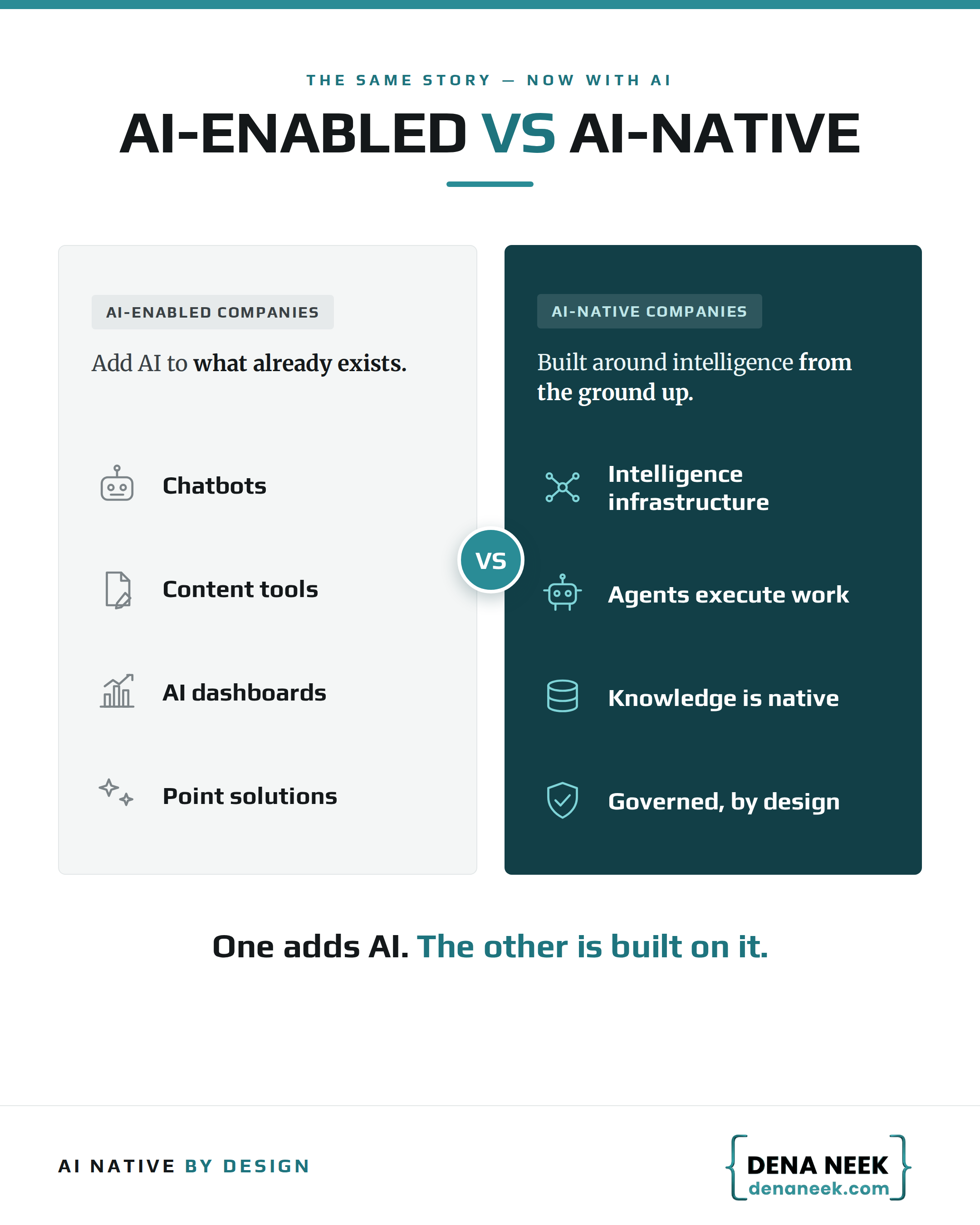
🔹 AI-assisted People do the same work, with AI helping at the edges.

🔹 AI-enabled AI is built into parts of the workflow, but the company can still run without it.

🔹 AI-native The business is redesigned so knowledge, decisions, and execution flow through intelligence infrastructure.

This is where most companies get stuck. They add AI to old workflows and expect transformation. But old workflows do not become modern because a model sits on top of them.

❌ The real question is not: "Are we using AI?" ✔️ The better question is: "If AI disappeared tomorrow, what would actually break?"

If the answer is "not much," you are still early.

Using AI vs becoming AI-native
AI-Native LeaderWhy Now

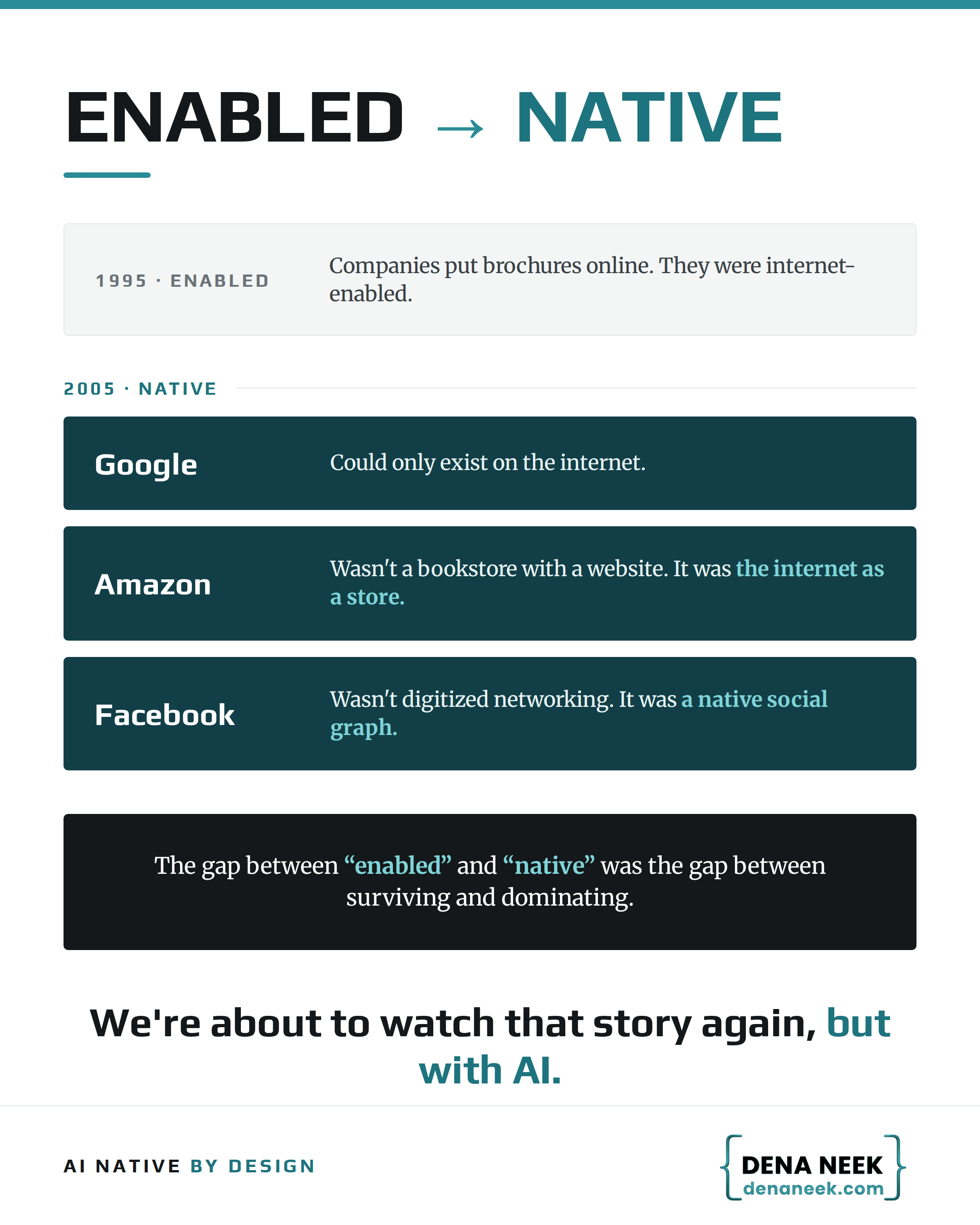
🌐 In the 1990s, every company wanted a website. They thought having a website made them an online business.

It didn't.

For most companies, the website was just a brochure on the internet. Same company. Same business model. Same operations. New surface.

The winners were different. Google could only exist on the internet. Amazon wasn't a bookstore with a website. It was the internet as a store. Facebook wasn't digitized networking. It was a native social graph.

The gap between enabled and native became the gap between surviving and dominating.

Now the same mistake is happening with AI. Most companies think adding AI tools makes them AI-native. It doesn't. Chatbots, copilots, dashboards, and content tools are the new brochure websites. Useful. Visible. But not structural.

💡 AI-native means the company is redesigned around intelligence. Knowledge is captured by default.

Agents execute work. Decisions write back to systems. Trust rails govern action.

The winners won't be the companies that "have AI." They'll be the companies built for it.

AI tools are the new brochure websitesAI tools are the new brochure websites
AI-Native LeaderAssisted vs Native

Most companies using AI today are not AI-native. They're AI-assisted. Some are becoming AI-enabled. Very few are AI-native.

🤖 AI-assisted companies add AI to existing work. ⚙️ AI-enabled companies embed AI into parts of the workflow. 🏗️ AI-native companies redesign the business around intelligence infrastructure.

What does that mean?

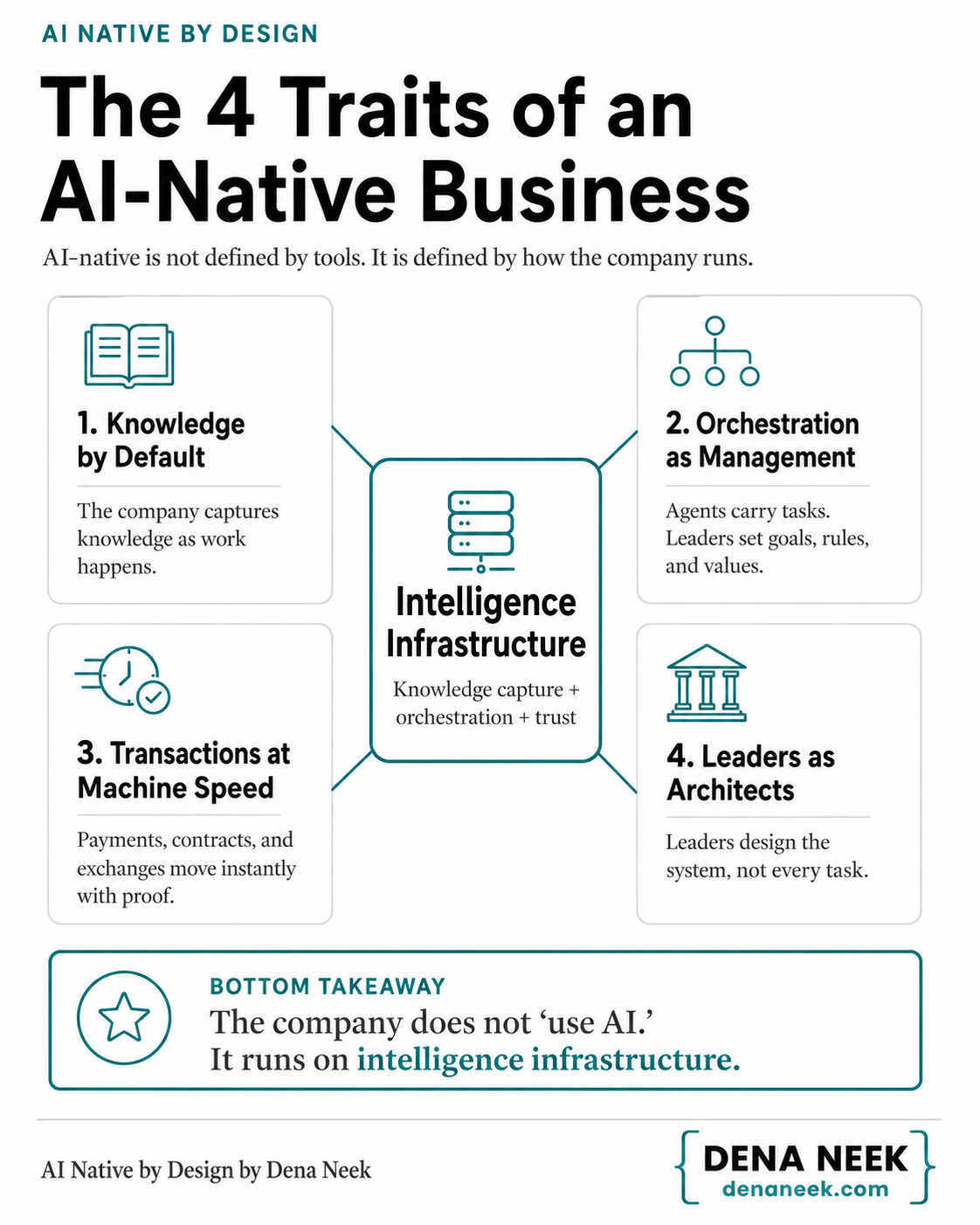
Four traits tend to show up repeatedly:

➡️ Knowledge by default Knowledge is captured as work happens.

➡️ Orchestration as management Agents execute tasks. Leaders set goals, rules, and values.

➡️ Transactions at machine speed Payments, contracts, and exchanges move with minimal friction.

➡️ Leaders as architects Leaders design the system instead of managing every task.

The difference is not the model. The difference is the operating system.

Most organizations are focused on AI adoption. The companies that win will focus on AI-native design.

💡 Which of the four traits do you think will be hardest for traditional companies to adopt?

The four traits of an AI-native company
AI-Native LeaderAssisted vs Native

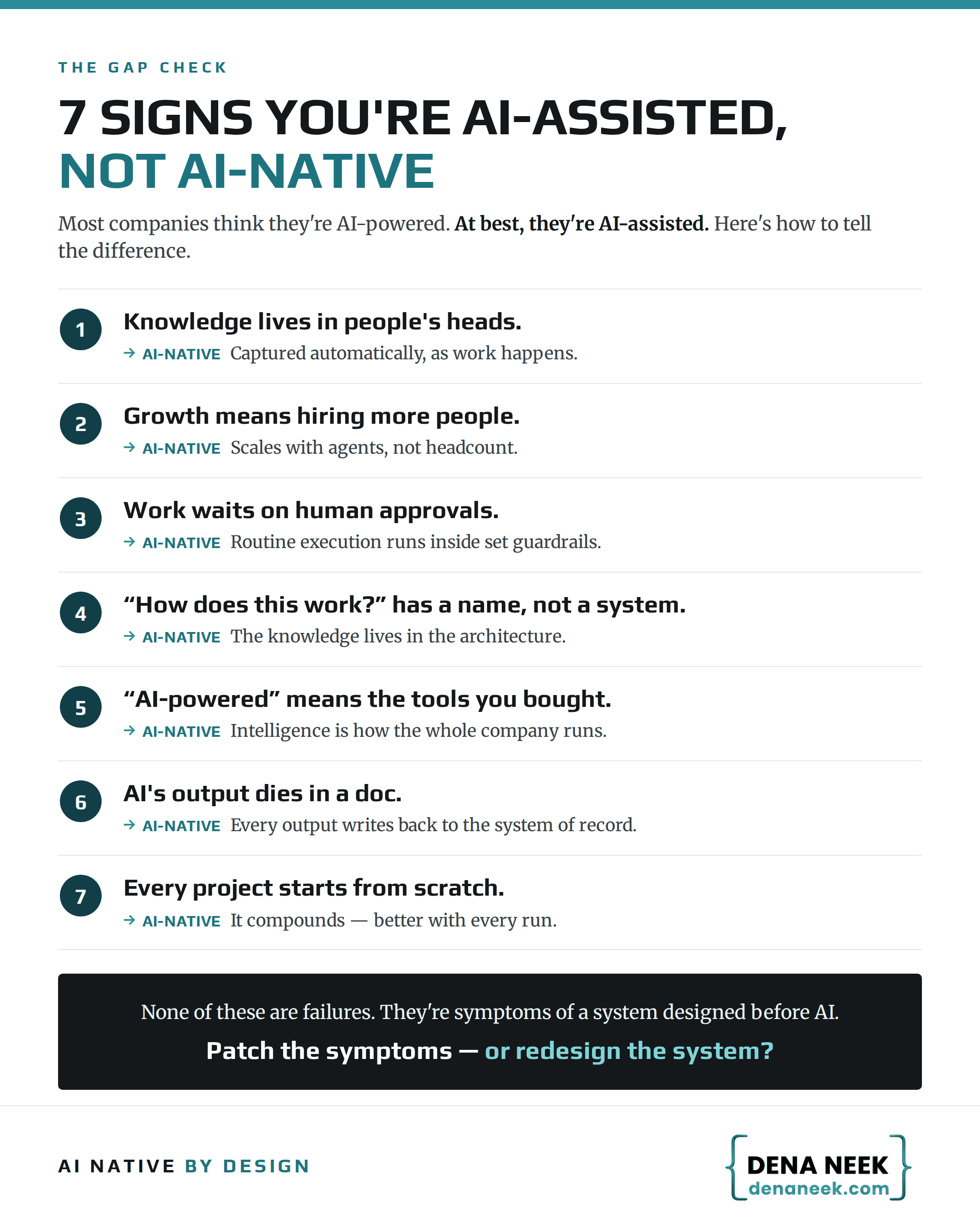
Most companies say they're "AI-powered." They're not. At best, they're AI-assisted.

The difference isn't how many AI tools you've bought. It's whether intelligence is bolted on or built in.

Here are 7 signs you're still AI-assisted, not AI-native 👇 1️⃣ Knowledge lives in people's heads, so it leaves when they do 2️⃣ Growth means hiring more people, so payroll scales and the system doesn't 3️⃣ Work waits on human approvals, so nothing moves without a signature 4️⃣ "How does this work?" has a name, not a system, always a person, never the architecture 5️⃣ "AI-powered" means the tools you bought, chatbots and dashboards on the same old workflows 6️⃣ AI's output dies in a doc, drafts that never write back to a system of record 7️⃣ Every project starts from scratch, the system never gets smarter

Here's the thing: None of these are failures. They're symptoms of a system designed before AI existed.

AI-native companies don't patch them one by one. They redesign the system so knowledge is captured automatically, agents scale the work, and every run leaves the system better than the last.

That's the gap between surviving and dominating the next decade.

So the real question isn't "are we using AI?" It's: patch the symptoms, or redesign the system?

👉 How many of the 7 describe your company right now? Drop a number in the comments.

7 signs you're still AI-assisted, not AI-native
AI-Native LeaderMemory, Not Storage

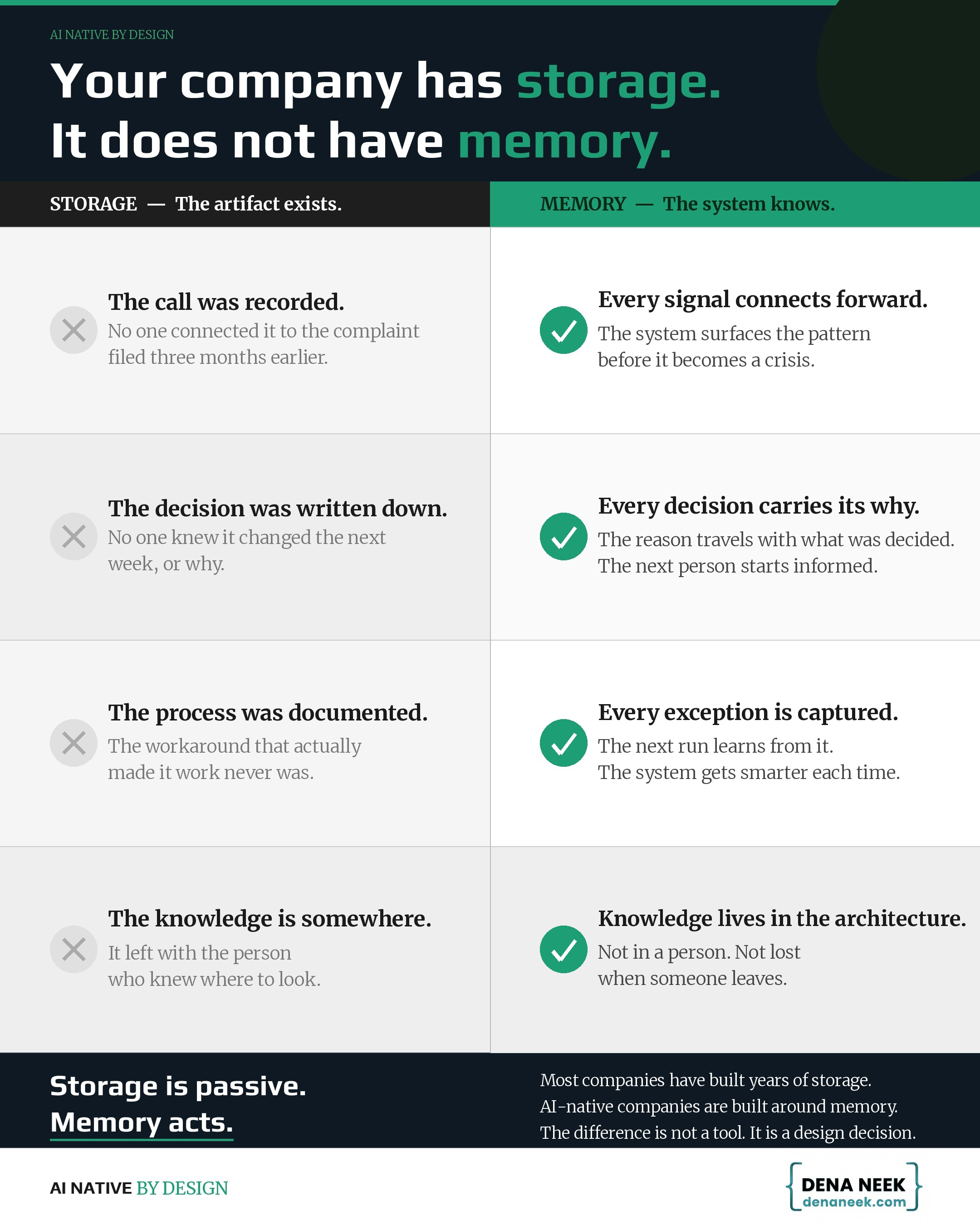
Your CRM has the account record. . Your project tool has the tasks. . Your call tool has the recording. . Your Slack has the thread. None of them know what the other knows. 📂 And somewhere in the gap between all of them, the actual state of your business lives in someone's head.

This is the difference between storage and memory.

🔸 Storage means the information exists somewhere. 🔹 Memory means the firm knows what happened, why it matters, and what to do next.

You can have perfect storage and zero memory. The call was recorded, but no one connected it to the complaint filed three months earlier. The decision was written down, but no one knew it changed the following week. The process was documented, but the workaround that actually made it work never was. ❌

Most companies have spent years building storage. Dashboards. CRMs. Note-taking tools. Knowledge bases. And yet every morning, someone has to reload context that the system forgot overnight.

The person becomes the API. The one every disconnected tool calls when it needs meaning. That works until it doesn't. It doesn't work when that person leaves. It doesn't work when the team scales. It doesn't work when the same mistake happens for the third time because the lesson never made it into the architecture. 🔄

An AI-native company is designed around memory, not storage. Every signal connects forward. Every decision carries its why. Every exception teaches the next run. Knowledge lives in the operating layer, not in a person. The firm remembers, so you don't have to.

What would change in your company tomorrow if your systems remembered everything your people currently have to carry?

Storage is not memory
AI-Native LeaderWhy Now

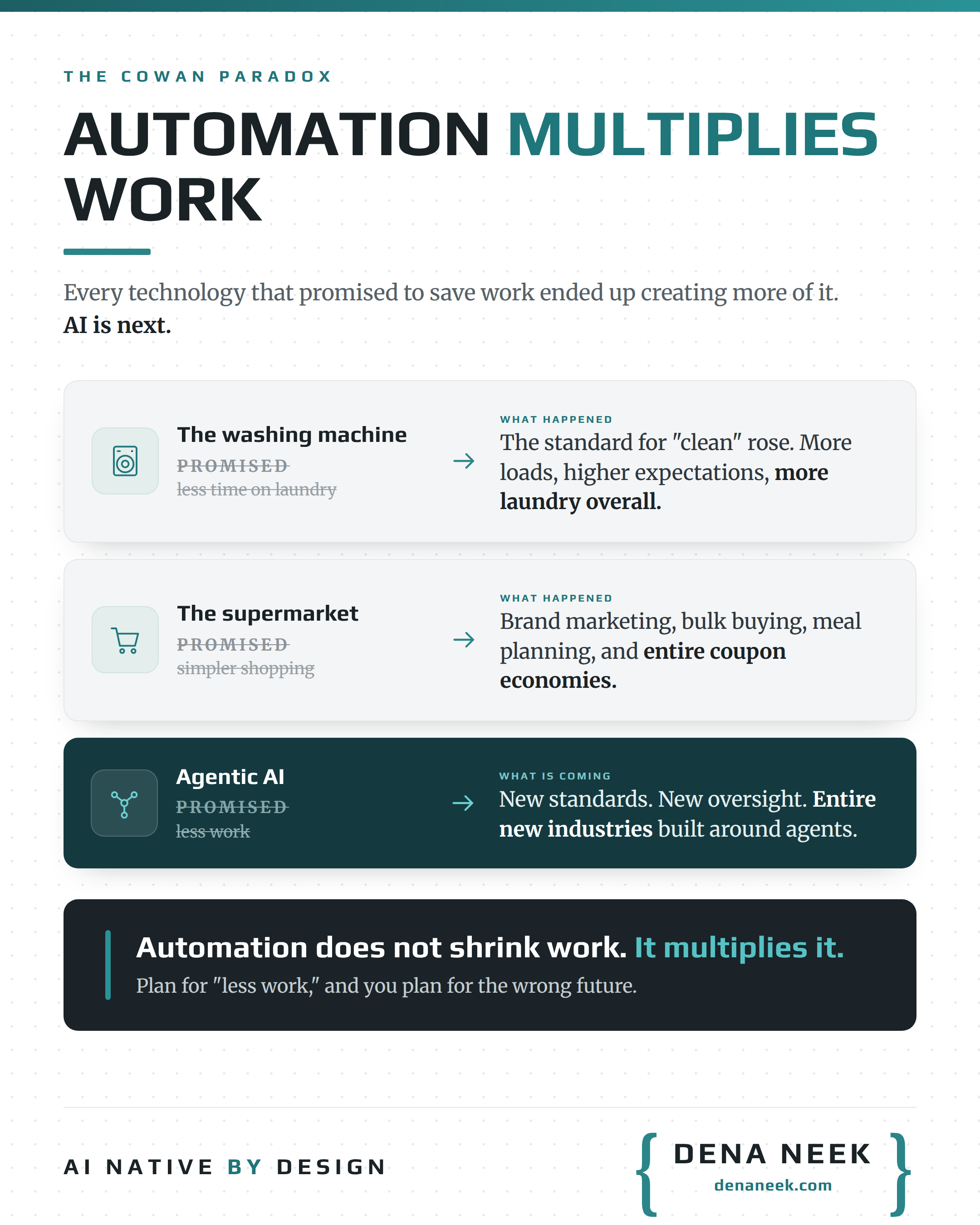
The washing machine was supposed to give people their time back. It did the opposite. Once washing got easier, the standard for "clean" went up. More loads, higher expectations, more laundry overall. The convenience did not reduce the work. It multiplied it. This is the Cowan Paradox, and it keeps repeating: 🧺 The washing machine promised less laundry. It raised the bar for "clean" and created more of it.

🛒 The supermarket promised simpler shopping. It created brand marketing, bulk buying, meal planning, and entire coupon economies.

🤖 Agentic AI promises less work. It will bring new standards, new oversight, and entirely new industries built around agents.

Execution is about to become abundant. Agents will draft contracts, reconcile accounts, and validate invoices without fatigue. But abundance does not mean less work. It means a higher baseline.

Just as the washing machine redefined "clean," AI redefines "good enough." Your customers will not ask for fewer insights. They will expect them faster, richer, and more personal.

The leaders planning for "less work" are planning for the wrong future.

If AI makes your core task ten times cheaper, what new expectation does that create for your customers?

The Cowan Paradox: AI won't give you less work
AI-Native LeaderWhy Now

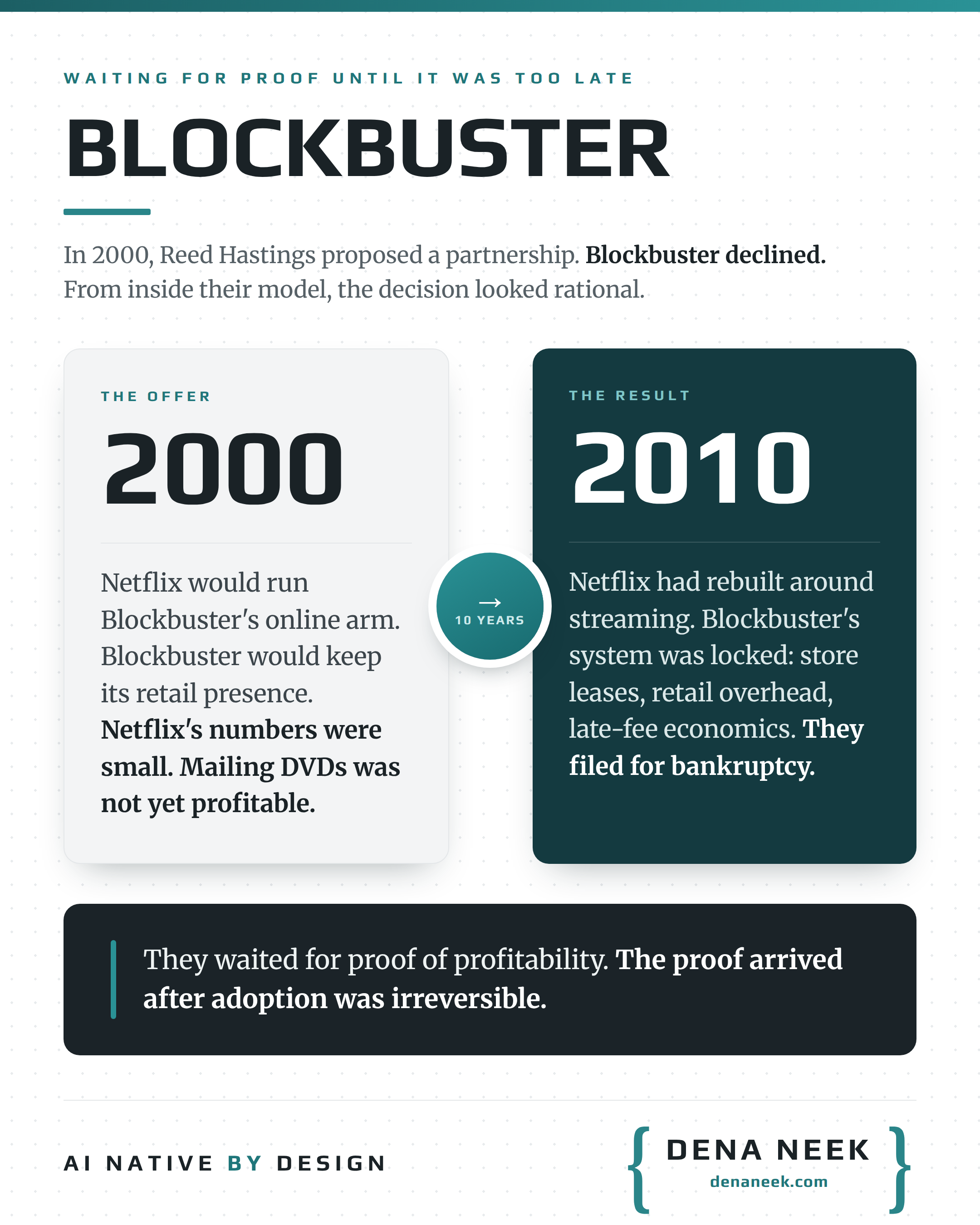
In 2000, Blockbuster had the chance to absorb Netflix. They said no. It was the rational call. 🎬

Netflix offered to run Blockbuster's online arm while Blockbuster kept its stores. Netflix was small. Mailing DVDs was not yet profitable. The curve had not bent. From inside Blockbuster's model, declining looked obvious.

A decade later, Netflix had rebuilt around streaming. Blockbuster tried to follow, but its system was locked: store leases, retail overhead, late-fee economics. By the time consumer behavior normalized around streaming, that infrastructure was a liability on every line of the balance sheet. They filed for bankruptcy in 2010.

Blockbuster did not lack resources. They lacked urgency at the moment urgency was still actionable.

Most firms reading this are at the same decision point. Not because AI is Netflix, but because a new model with a fundamentally different cost structure is entering from below. The window to redesign before it reaches the center of the market is measured in years, not decades.

Waiting for certainty is the riskiest position. Certainty arrives after the inflection. The inflection is what closes the window.

What proof are you waiting for before you redesign?

Blockbuster didn't lack resources. It lacked urgency.
AI-Native LeaderDesign the Defaults

In Germany, about 12% of people consent to be organ donors. In Austria, it is close to 100%. Same region. Same values. Neighboring countries. The difference is not culture. It is one line on a form: in Germany you opt in, in Austria you opt out. Nobody is choosing differently. The default is choosing for them.

Your company is full of these same defaults. You just don't call them that: . The dollar amount under which a refund clears with no review. . The discount a salesperson can give without asking anyone. . Which complaints get escalated, and which ones quietly wait. . The reorder quantity nobody has touched in three years.

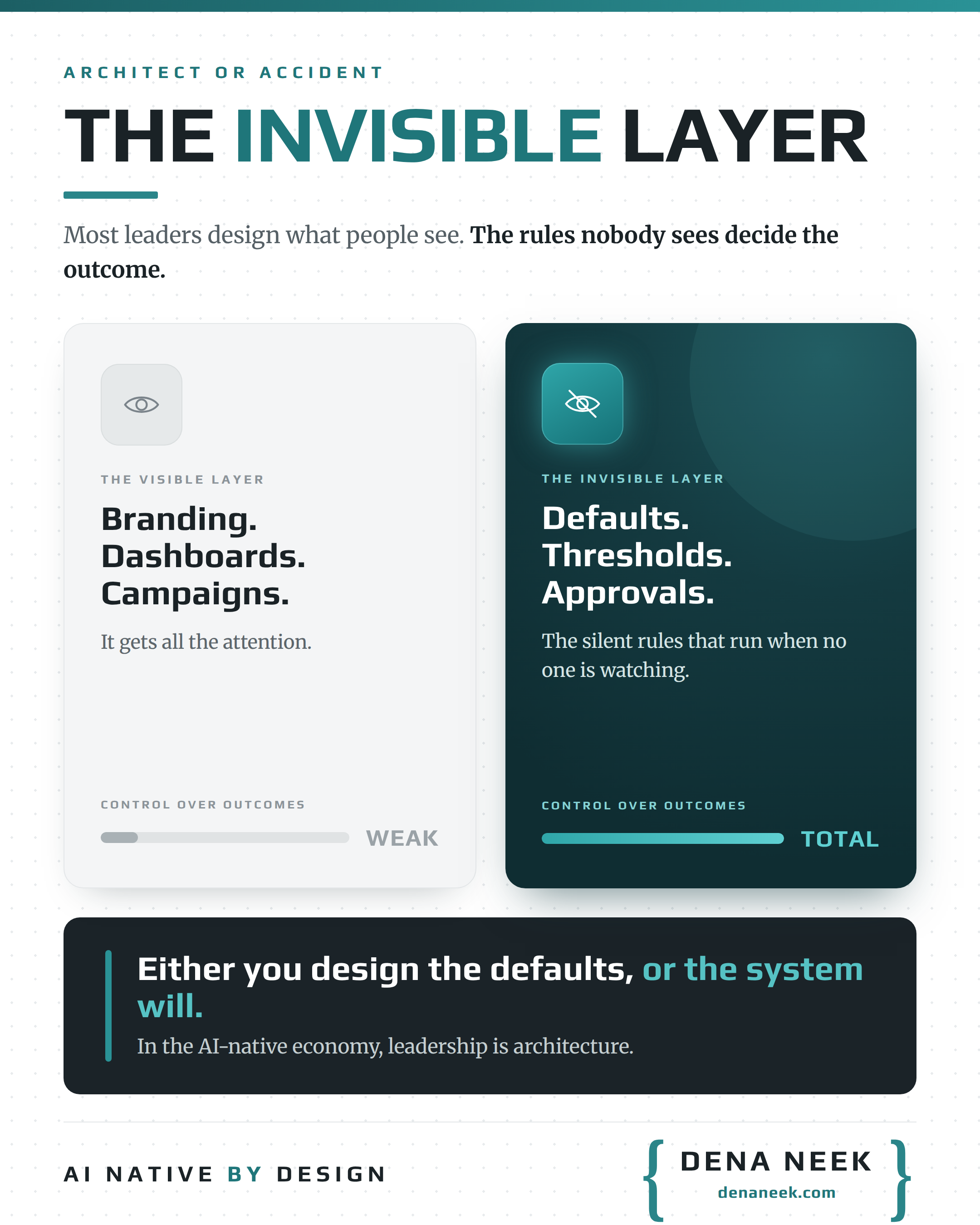
Each one runs hundreds of times a week. Most were never really decided. They became the default and stuck. 👀 The visible layer (your brand, your dashboards, the pitch deck) gets all the attention. ⚙️ The invisible layer (these silent defaults) is what actually decides the outcome. 🤖 Now hand that layer to AI. An agent does not stop to ask whether the refund limit still makes sense. It runs the rule, instantly, thousands of times, before anyone looks.

Either you design the defaults, or the system runs on whatever was already there. And whatever was there was usually an accident.

What is one default in your business that nobody actually chose?

Every company runs on defaults nobody chose