AI NativeLeader

Issue 01 · Posts

Tools Don't Transform. The Operating Model Does.

The 5 short posts threaded into this issue — the atoms behind the weekly read. Read the full issue →

AI-Native LeaderAdoption vs Maturity

🔍 The most dangerous line in your AI strategy is "we already do this."

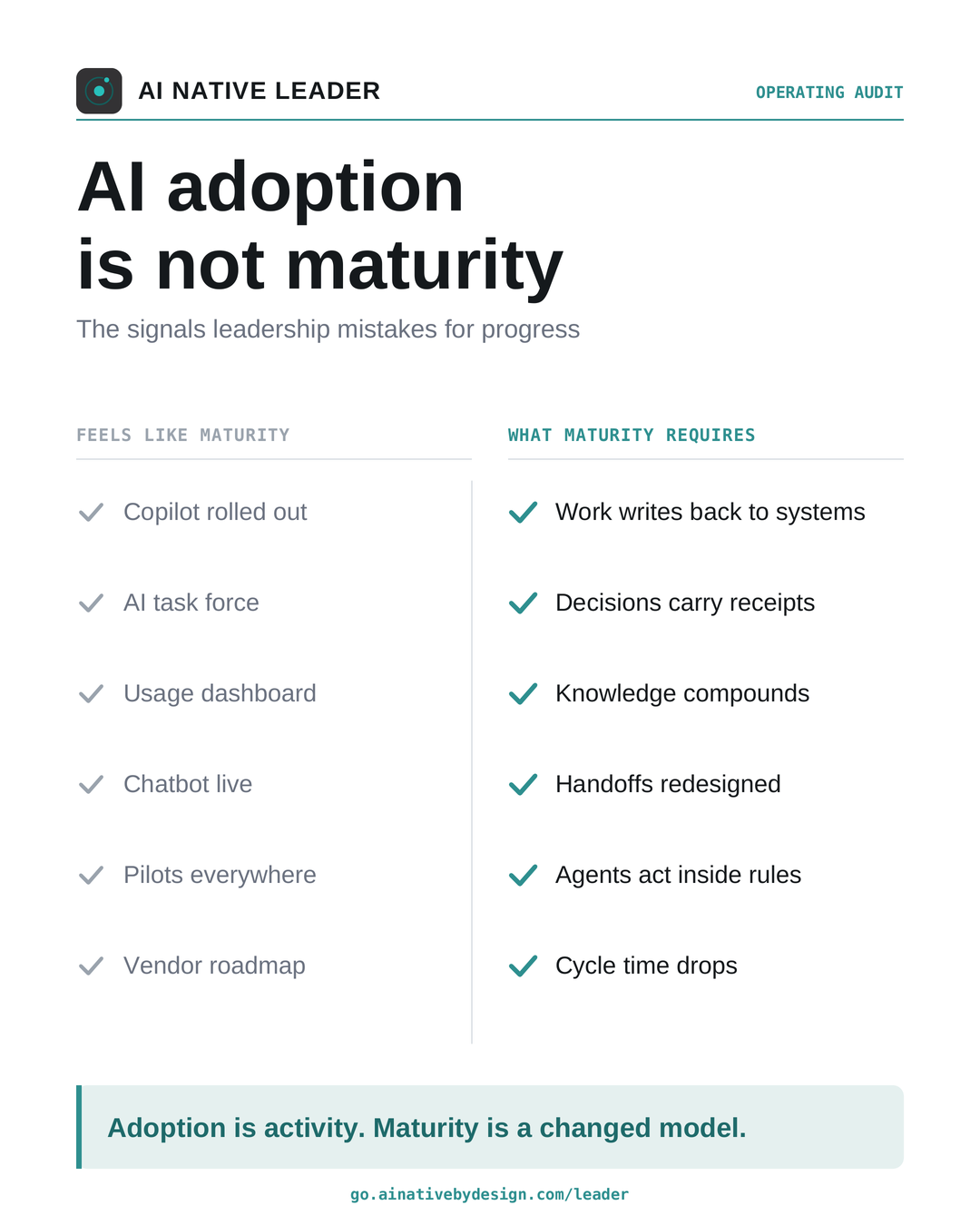
Adoption measures activity. Maturity shows up when the operating model changes.

A company-wide Copilot rollout, an AI task force, a usage dashboard climbing up and to the right: all real, none of them maturity. They prove you are using AI. They do not prove anything got rebuilt.

So run the only test that matters. If cycle time, handoffs, decision rights, memory, or margin did not change, you adopted AI. You did not mature the operating model.

Most leadership teams are scoring activity and calling it transformation. The dashboard goes up. The way the company runs stays exactly the same.

Which side of the card is your company actually on?
AI adoption is not maturity
AI-Native LeaderThe Shared Layer

🧩 Every function bought its own AI. Nobody bought the connection between them.

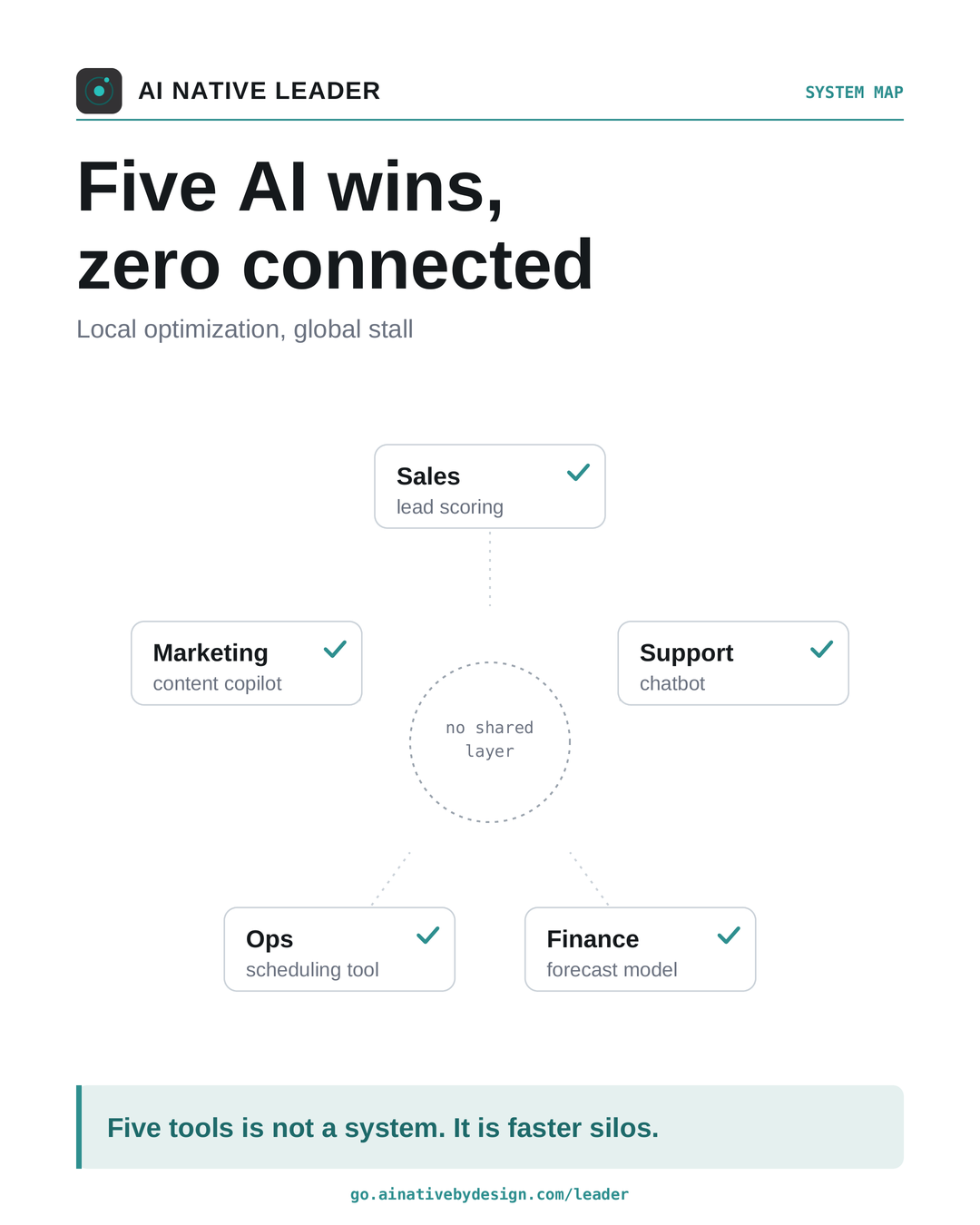
Sales has lead scoring. Support has a chatbot. Finance has a forecast model. Ops has a scheduler. Marketing has a content copilot. Five green checks. Five real wins.

And the business still moves at the speed of the handoffs nobody automated.

Each tool optimizes one box. None of them shares memory, rules, or a workflow with the next. So the moment work crosses a boundary, a person picks it up, reloads the context, and carries it across by hand.

That person is your integration layer. They are also your bottleneck, your single point of failure, and the reason the same issue gets re-solved three times a quarter.

Local speed went up. The company did not. You got five fast silos and the same slow seams.

AI-native is not five copilots. It is the shared layer underneath them: one memory, one set of rules, one workflow the agents move through.

Where does work in your company still cross a boundary on a person's back?

Five AI wins, zero connected
AI-Native LeaderTrust Rails

🧾 You bought AI to move faster. Now it moves faster than your ability to prove what it did.

There are three ways to handle that. Most companies back into one of the first two.

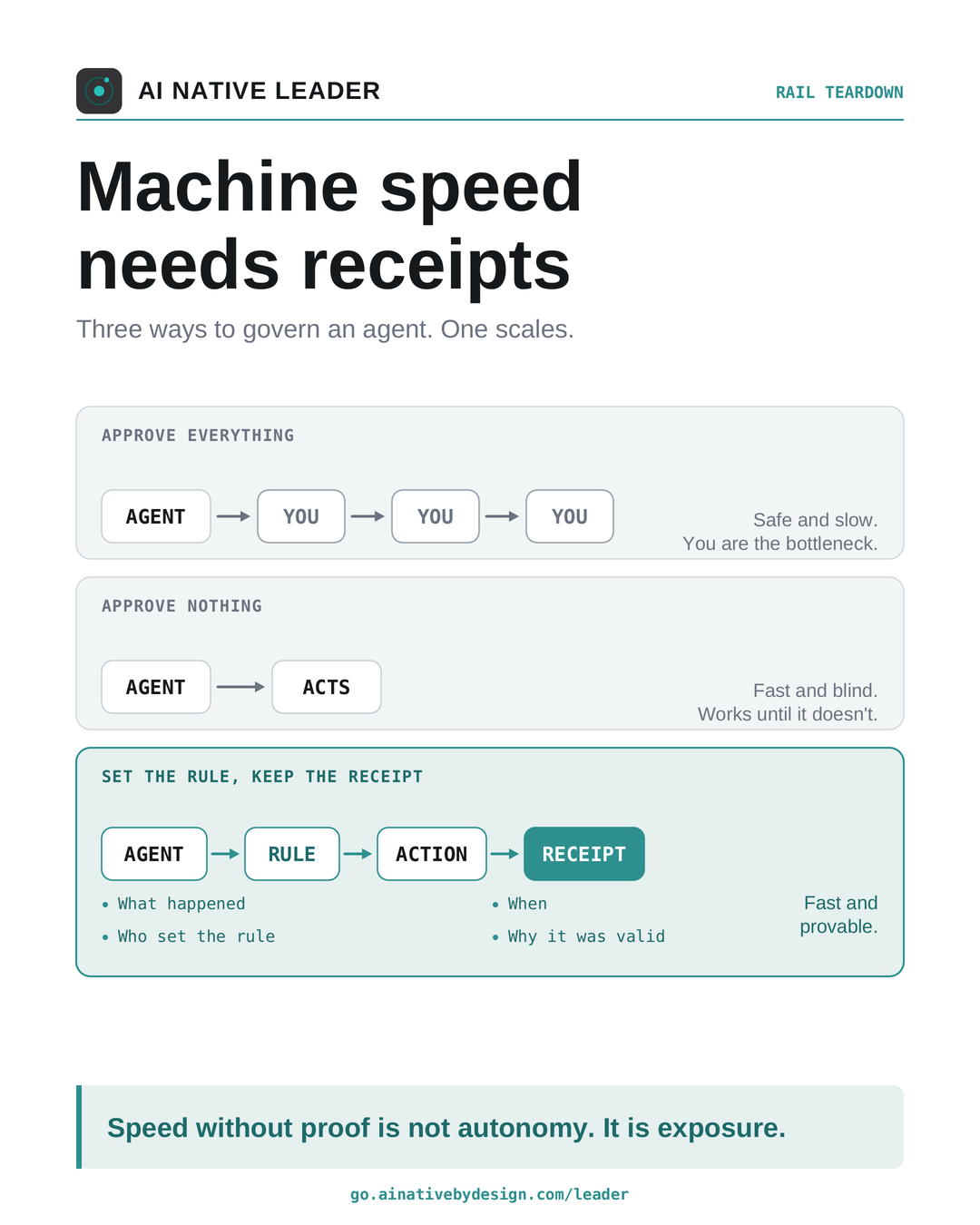
Approve every action manually. Safe, and slow enough that you become the thing the AI waits on. You bought machine speed and capped it at your inbox.

Approve nothing and let agents run. Fast, until something breaks and you cannot reconstruct what happened, who allowed it, or why. That is not autonomy. It is exposure with good uptime.

The third way is the only one that scales. Set the rule once: the exact condition under which an agent may act. Keep the receipt: what happened, when, who set the rule, and why it was valid. Routine work flows. Exceptions escalate to a human with the context attached.

The goal is not to slow the AI down. It is to make its speed provable, so it can run without you watching it.

If an agent acted in your business an hour ago, could you show what it was allowed to do, and who decided?

Machine speed needs receipts
AI-Native LeaderMemory, Not Pilots

📈 You ran twelve AI pilots. Your company is exactly as smart as it was before the first one.

Each worked in the demo. Each got a slide. And each started from zero, because nothing the last one learned was waiting for the next.

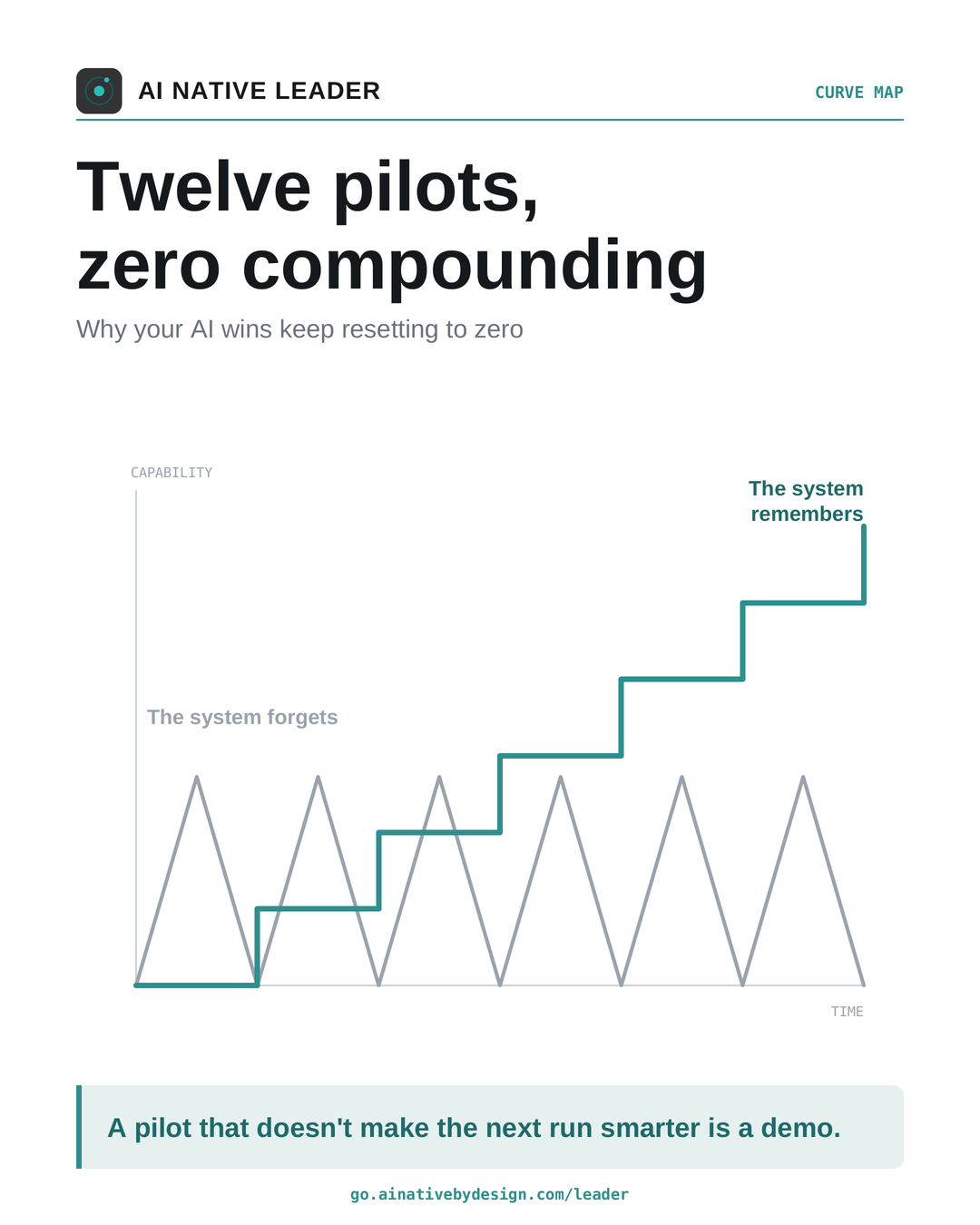
That is the difference between activity and compounding. Most pilots spike and reset: the capability shows up, the project ends, the system drops back to baseline. Run that twelve times and you get twelve sawtooths, not a curve.

The trap is thinking you need a better model. You do not. A pilot that does not write back to a memory layer is a demo, not infrastructure. It can write to a CRM, hit its metric, and still leave the company no smarter, because the memory the next run needs was never captured.

Stop scoring pilots on whether they worked. Score them on whether they made the next run start higher.

How many of your AI wins would survive the pilot team leaving tomorrow?

Twelve pilots, zero compounding
AI-Native LeaderOne Definition

🧭 Ask five executives what "AI-native" means for the business. You will get five answers. That is the problem.

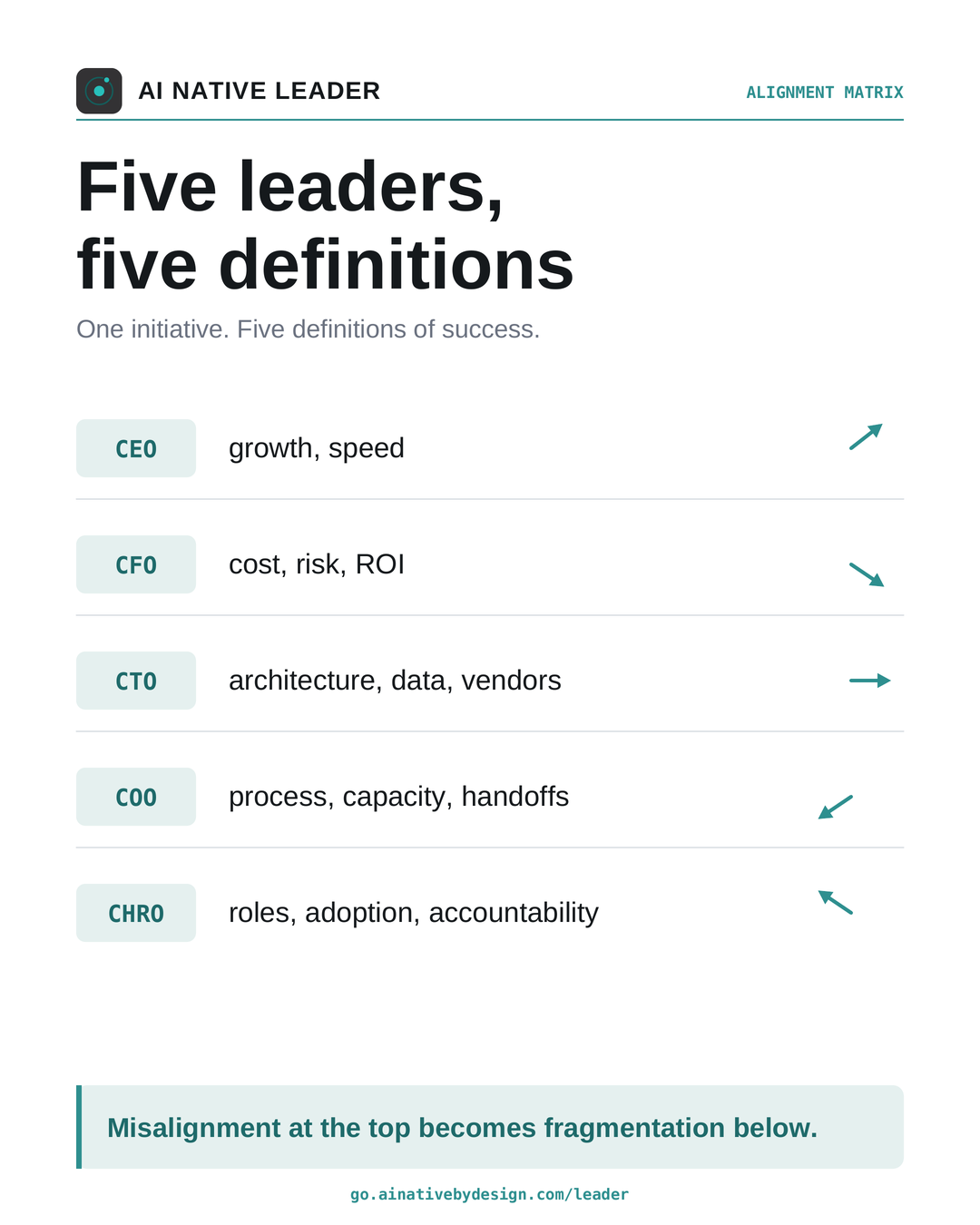
To the CEO it means growth and speed. To the CFO, cost, risk, and ROI. To the CTO, architecture, data, and vendors. To the COO, process, capacity, and handoffs. To the CHRO, roles, adoption, and accountability.

Every one is legitimate. Together they are five initiatives wearing one name.

So each leader funds their version. Five budgets. Five sets of metrics. Five pilots pointed in five directions. Then everyone wonders why the transformation feels busy and goes nowhere.

This is where the silos start. Fragmentation below is not a coordination failure. It is a faithful reflection of a leadership team that never agreed on what it was building.

Tools do not transform a business. A shared operating model does, and that starts with one definition the leadership team stands behind, before a single budget is approved.

The companies that pull ahead are the ones whose leaders were building the same thing.

Put your team in a room and ask. Would you get one definition, or five?

Five leaders, five definitions