AI Native Leader · Issue 01 · The Operating Model
Tools Don't Transform. The Operating Model Does.
Five enemies of AI transformation went on the table this week. Not one of them is the model. All five are the operating model.
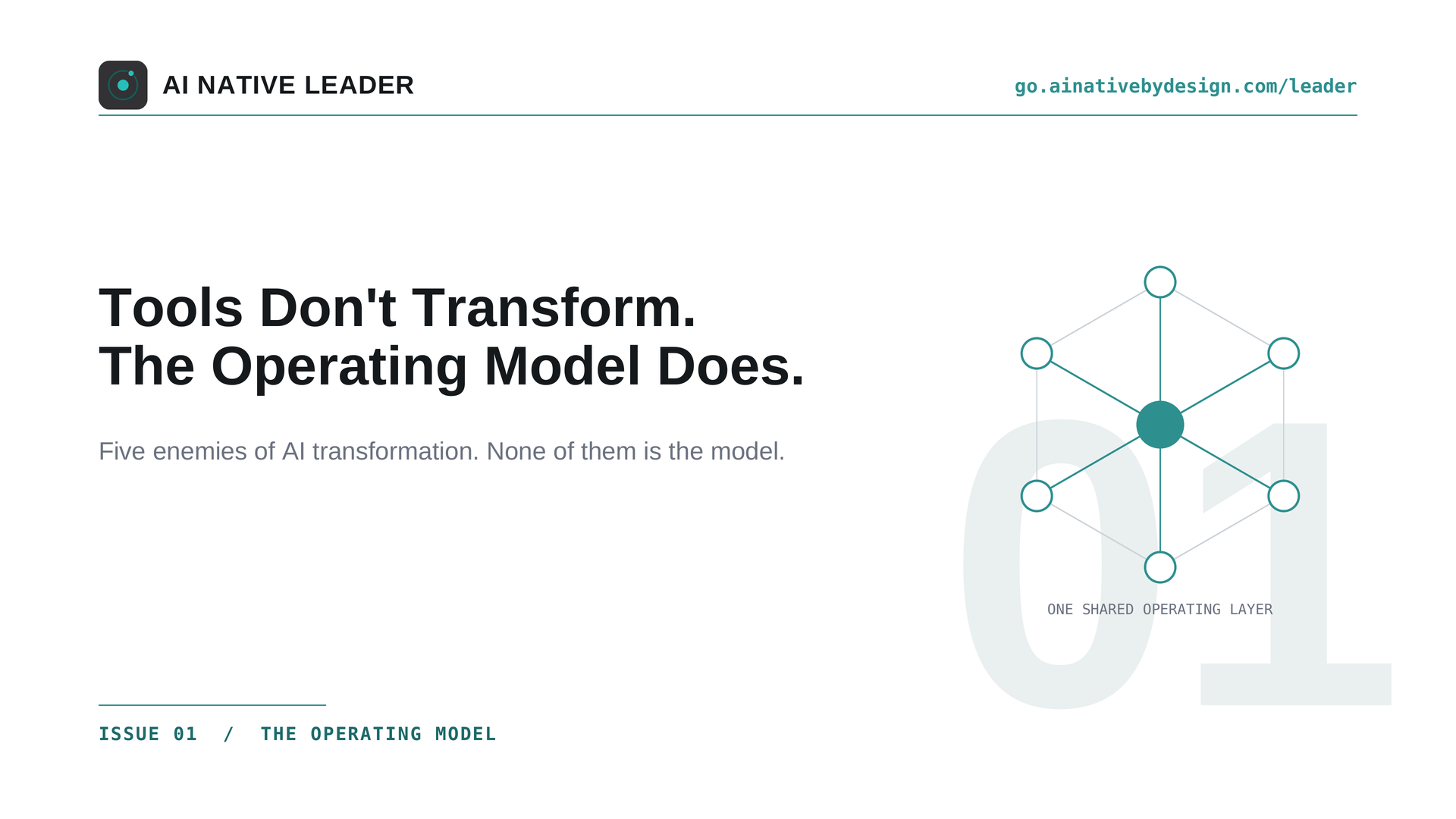
Every company in your market has access to the same models. The frontier is a commodity now, priced by the token, available to anyone with a card. So the question that decides the next decade is not which AI you bought. It is whether the way your company remembers, decides, and acts was redesigned around it, or whether you bolted intelligence onto an operating model built for a slower world.
Most companies are doing the second thing and calling it the first. They count seats, pilots, and dashboards as proof of transformation, then wonder why the demo felt like magic and the rollout feels like a rounding error.
This week named the five reasons that gap exists. Read them as a diagnosis, not a scolding. Each one is an operating-model failure wearing an AI costume.
False maturity. Adoption measures activity. Maturity shows up when the operating model changes. If cycle time, handoffs, decision rights, memory, or margin did not move, you adopted AI. You did not mature.
Functional fragmentation. Every function bought its own AI and nobody bought the connection between them. Five local wins, zero shared layer, and a person still carrying context across every seam by hand.
Ungoverned speed. The agent acts in seconds and you cannot prove what it did. Approving everything makes you the bottleneck. Approving nothing makes you exposed. The third option is to set the rule once and keep the receipt.
Non-compounding pilots. A pilot that does not write back to a memory layer is a demo, not infrastructure. Run twelve of them and you get twelve sawtooths, not a curve. The company is exactly as smart as it was before the first one.
Executive misalignment. Ask five leaders what AI-native means and you get five answers. Five definitions buys five budgets pointed in five directions. The fragmentation below is just the misalignment above, made visible.
Tools are a purchase. An operating model is a design. Only one of them compounds.