AI Native Leader · Issue 02 · The Trust Series
Set the Rule. Keep the Receipt.
This week was about the one thing no vendor can sell you: the ability to let AI act at machine speed and prove, every time, that it was allowed to.
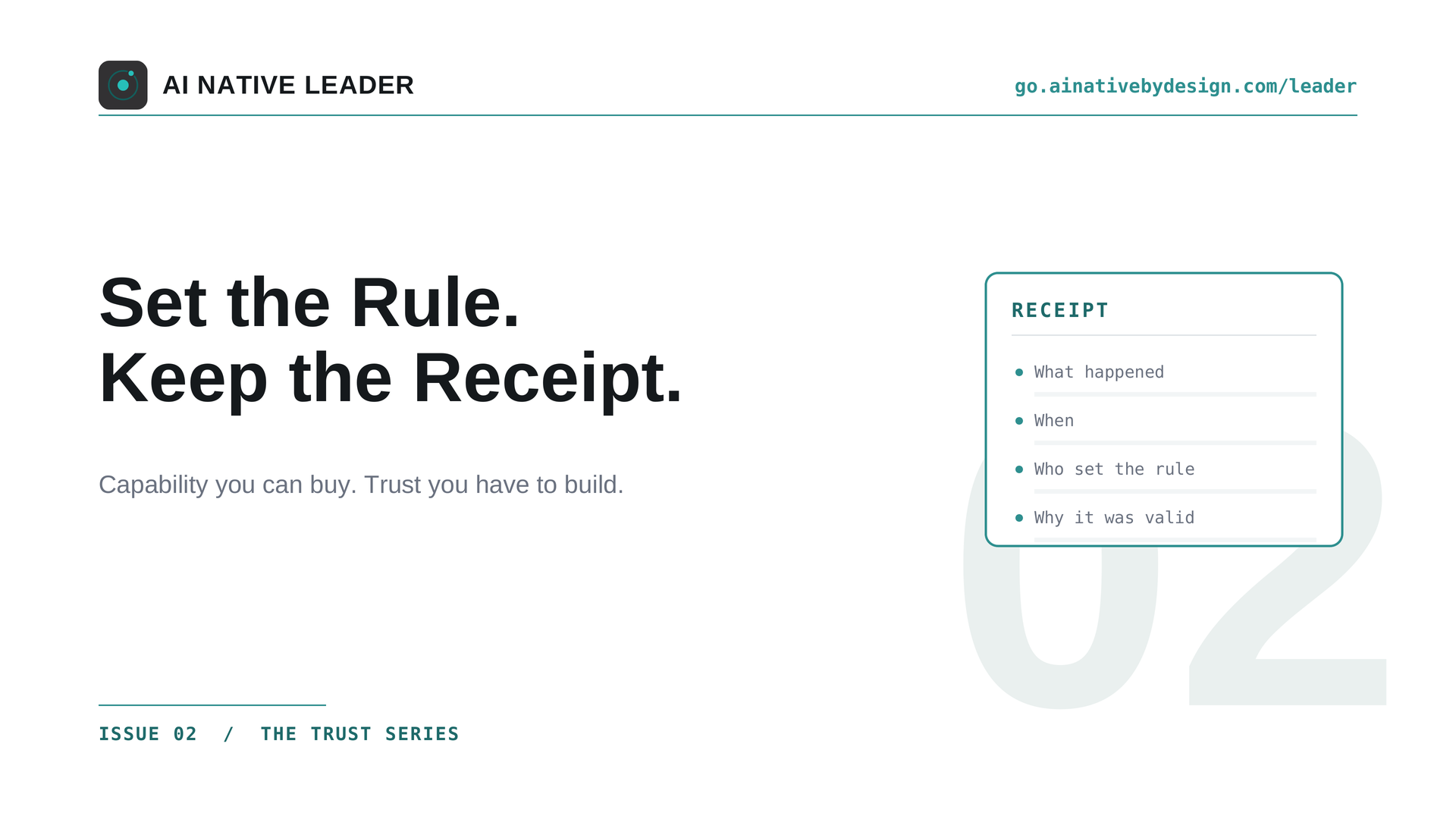
You can buy capability. You cannot buy trust. Capability is what the model does. Trust is whether you can let it act on your money, your customers, and your systems without watching every move, and prove afterward that it stayed inside the lines. One ships in the box. The other is something you design.
Most companies discover this in the wrong order. They hand AI a task, it works in the demo, and only later does someone ask the question that matters: if this acted on its own at 3am, could we show what it did, who allowed it, and why it was valid? For most, the honest answer is no. Not because AI is dangerous, but because they prove trust too late, reconstructing it from memory and email after the fact.
This week laid out the trust rail: the small, reusable machinery that lets an agent run, and leaves proof behind every time it does.
The real leak is shadow AI. The enterprise tools you pay for do not train on your inputs. Your own team pasting the client list into a free app does. The threat was never the model. It was the rule you never set.
You are the bottleneck. Intelligence runs at machine speed. Your sign-off runs at clerk speed. Set the rule once and let routine work flow through it, so you handle exceptions instead of every yes.
Rule plus receipt. Letting AI touch money does not mean watching it. It means one condition under which it may act, and a tamper-proof record that the condition was met and someone is accountable.
Could you pass your own audit?. Most companies cannot, because the rule lives in one person's head and the audit trail is a group chat. The fix is capturing proof when things happen, not rebuilding it at quarter close.
Build the guardrails once. You do not supervise every task forever. You design a reusable bundle, proof points, approval logic, safety checks, an immutable receipt, and metrics, then snap it onto any risky workflow. The bundle is the workflow.
Slow trust is a design choice. A three-day refund is not normal, it is proof captured too late. On a rail, the condition clears in seconds and exceptions surface to a human with context attached.
Own the proof. A trust setup locked inside one vendor is a walled garden with good audit logs. Own the proof, the rules, the receipt, and the metrics, and switching vendors is just an infrastructure change.
Designed, not assumed. Letting AI run while you sleep takes four things true first: permissions set, failure handling designed, escalation explicit, audit log non-negotiable. Miss one and autonomy is just a liability that works until it doesn't.
Capability you can buy. Trust you have to build.