AI NativeLeader

Issue 02 · Posts

Set the Rule. Keep the Receipt.

The 8 short posts threaded into this issue — the atoms behind the weekly read. Read the full issue →

AI-Native LeaderShadow AI

🔒 You're holding back from AI because it might leak your secret sauce.

Good instinct. Wrong target.

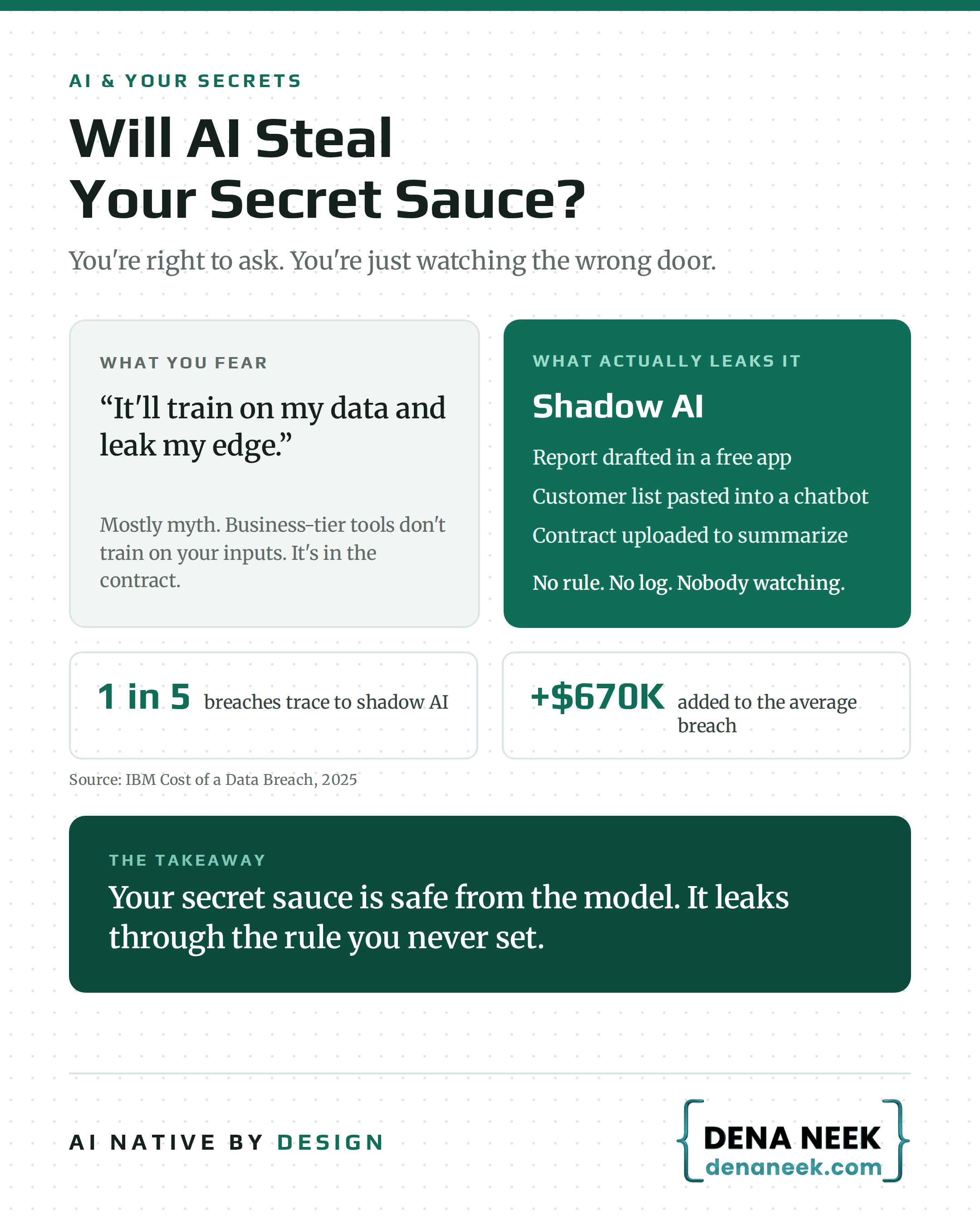
The enterprise tools you pay for don't train on your inputs. That's in the contract, not the marketing. The model isn't where your edge walks out.

Your own team is.

Someone drafts a confidential deck in a random free app. Someone pastes the client list into a chatbot to clean it up. Someone uploads the contract to summarize it faster. No rule. No log. Nobody watching.

That's shadow AI, and it's the actual leak.

IBM's 2025 breach research: one in five breaches now trace back to it, and heavy shadow AI use adds an average of $670,000 to the cost.

Here's the part that should change how you sleep. The threat was never the AI. It was the rule you never set. You don't fix it by banning the tools. You fix it by giving people an approved path with the rules built in.

So the real question isn't "is AI safe to use?"

It's this: where is your secret sauce walking out the door right now, and would you even see it go?
Shadow AI is the actual leak
AI-Native LeaderEarned Autonomy

⚡ You bought AI to move faster. You're the reason it isn't.

Be honest about how it actually goes.

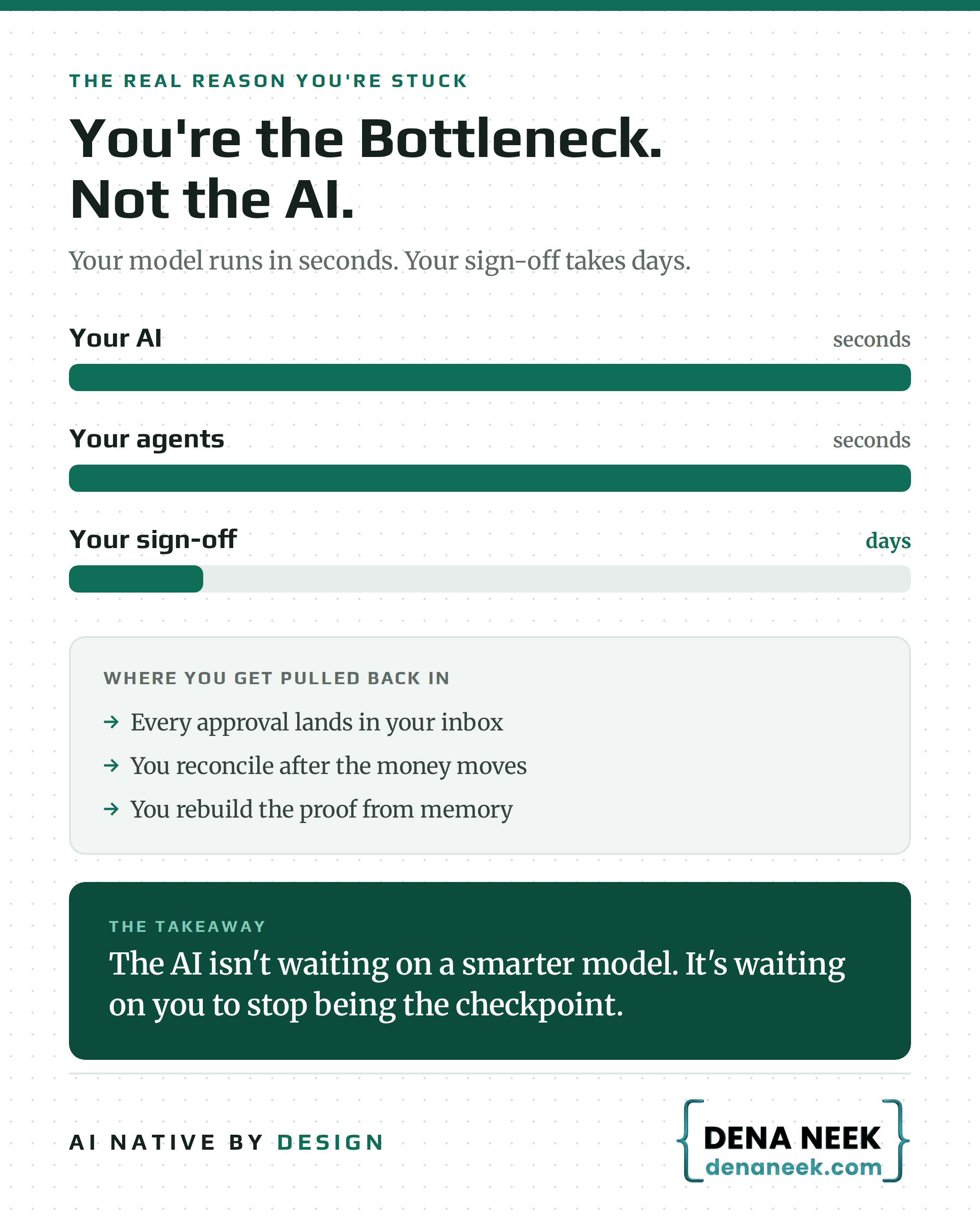
The model returns the answer in seconds. The agent is ready to act. Then everything stops, because it lands in your inbox waiting for your yes.

Intelligence runs at machine speed. Agents run at machine speed. Your sign-off runs at clerk speed.

So you get the worst of both worlds: a system smart enough to act instantly, stuck waiting days on you.

This is why the demo felt like magic and the rollout feels like a letdown. Nothing is wrong with the model. The bottleneck is the approval, the proof, and the record, all still routed through you.

You can keep being the checkpoint. Or you can set the rule once and let the routine work flow through it, while you handle the exceptions instead of every yes.

Where in your week does your fastest system still sit waiting on your slowest approval?

You bought AI to move faster. You're the reason it isn't.
AI-Native LeaderTrust Rails

💸 The scariest part of AI isn't what it knows. It's letting it touch your money.

So here's how you do that without watching every move.

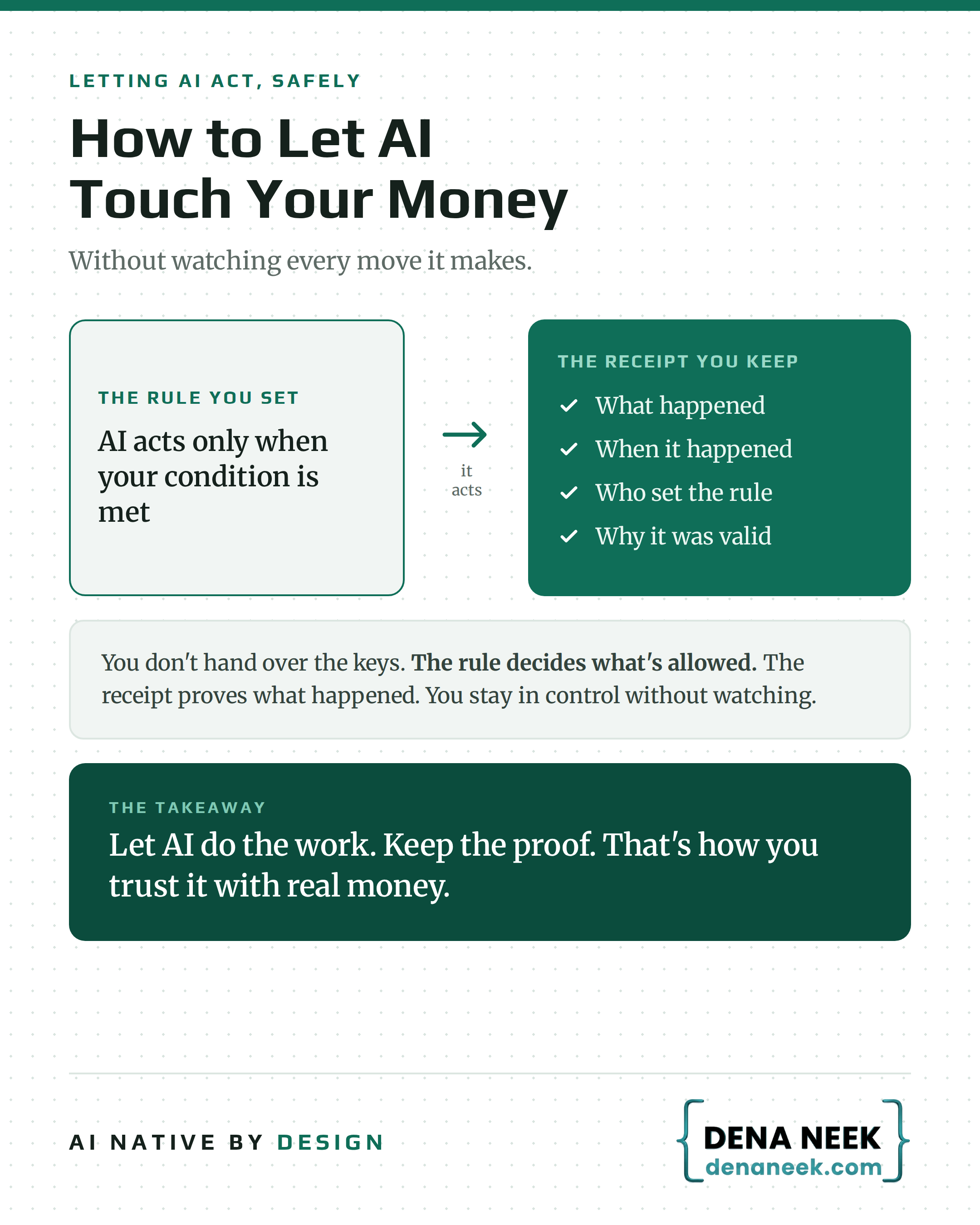
You don't hand over the keys. You give it a rule and you keep the receipt.

The rule sets the one condition under which it's allowed to act. The receipt is the tamper-proof record that the condition was met and someone is accountable.

A normal payment moves money from A to B. A payment on a trust rail moves only when the condition is met, and it leaves proof behind: what happened, when, who set the rule, and why it was valid.

That's the whole trick. The rule decides what's allowed. The receipt proves what happened. You stay in control without hovering.

Most people think trusting AI with money means watching it constantly. It's the opposite. You set the rule once, and the system proves itself every time.

If AI moved money in your business today, could you prove what happened in ten seconds, or would you be digging through email?

Letting AI touch your money: a rule and a receipt
AI-Native LeaderTrust Rails

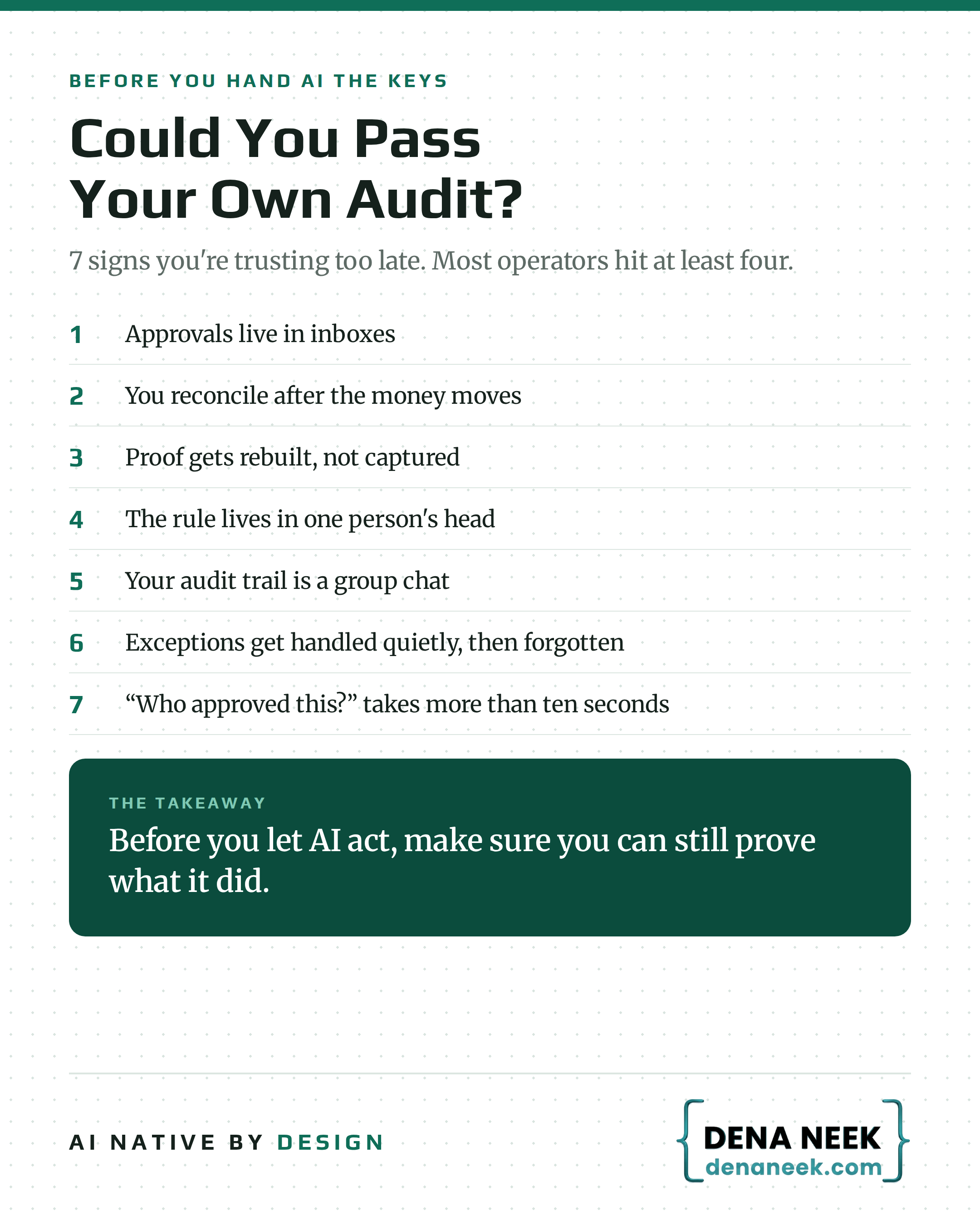
🚩 Before you let AI touch anything, ask one question: could you pass your own audit?

Most companies can't. Not because they're careless, but because they prove trust too late.

Finance closes the quarter, finds the mess, and reconstructs the story from memory and email threads. That works when humans move at human speed. It falls apart the second an agent moves at machine speed.

The graphic has all seven signs. The ones that catch most operators:

The rule lives in one person's head. The audit trail is a group chat. And "who approved this?" takes more than ten seconds to answer.

If those sound familiar, you're not ready to hand AI the keys yet. Not because AI is dangerous, but because you can't yet prove what your own business already does.

The fix isn't more oversight. It's capturing the proof at the moment things happen, instead of rebuilding it afterward.

How many of the seven would your company fail right now?

Could you pass your own audit?
AI-Native LeaderTrust Rails

🛠️ "How do I stop AI from going off the rails?" is the wrong-sized question.

You don't supervise every AI task forever. You build the guardrails once and reuse them.

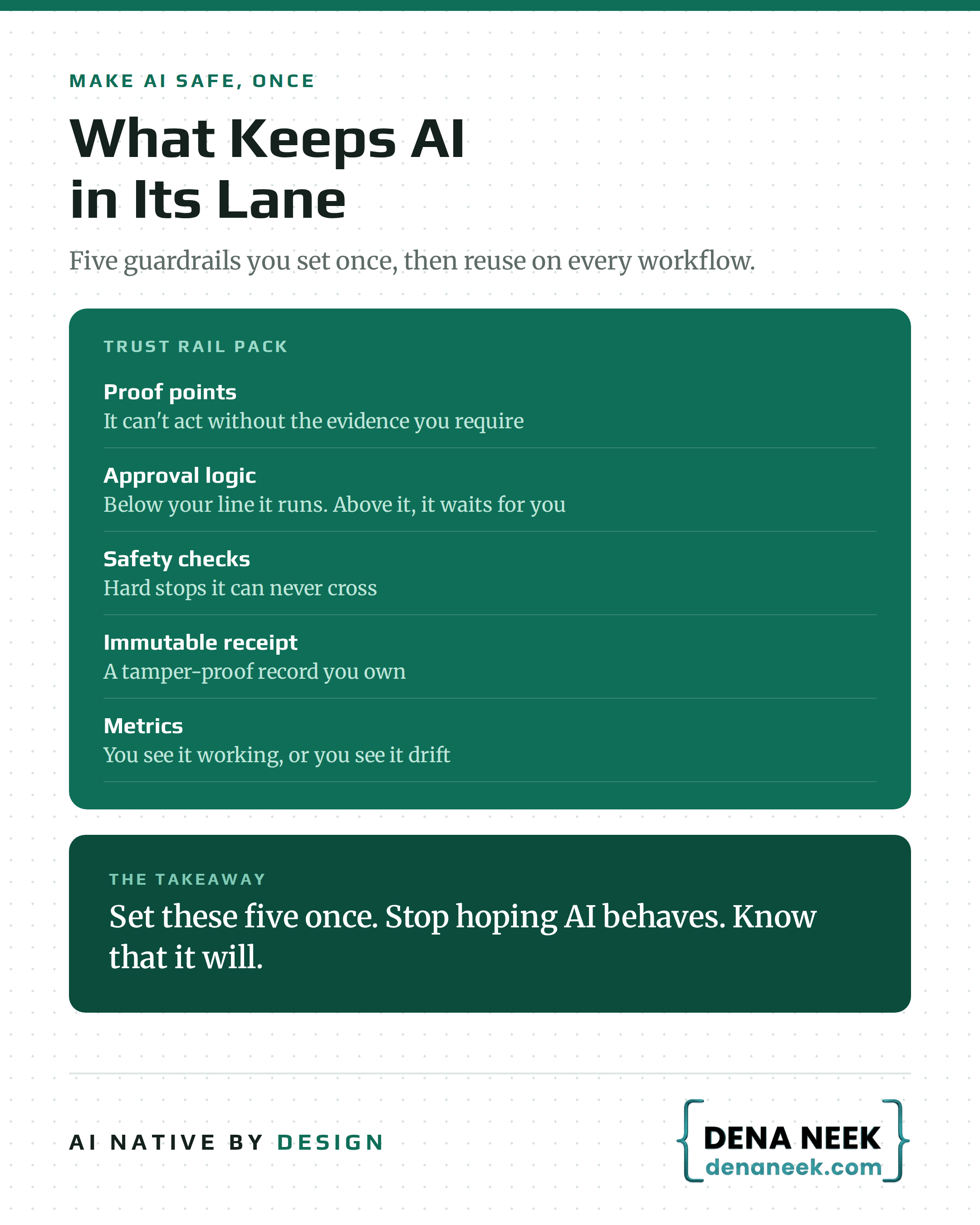
Call it a Trust Rail Pack: a reusable bundle you design one time and snap onto any workflow that carries risk. Five parts:

Proof points, so it can't act without the evidence you require. Approval logic, so below your line it runs, and above it, it waits for you. Safety checks, the hard stops it can never cross. An immutable receipt you own. And metrics, so you can see it working or see it drift.

The part people miss: this isn't bolted onto the workflow as a compliance layer. The Pack is the workflow.

Set it once, and you stop hoping AI behaves. You know it will, and you can prove it.

What's one workflow you'd never let AI near today, only because you don't have the guardrails for it yet?

Build the guardrails once: the Trust Rail Pack
AI-Native LeaderTrust Rails

⏱️ A customer returns something. The refund takes three days. Everyone shrugs and calls it normal.

It isn't normal. It's just slow trust.

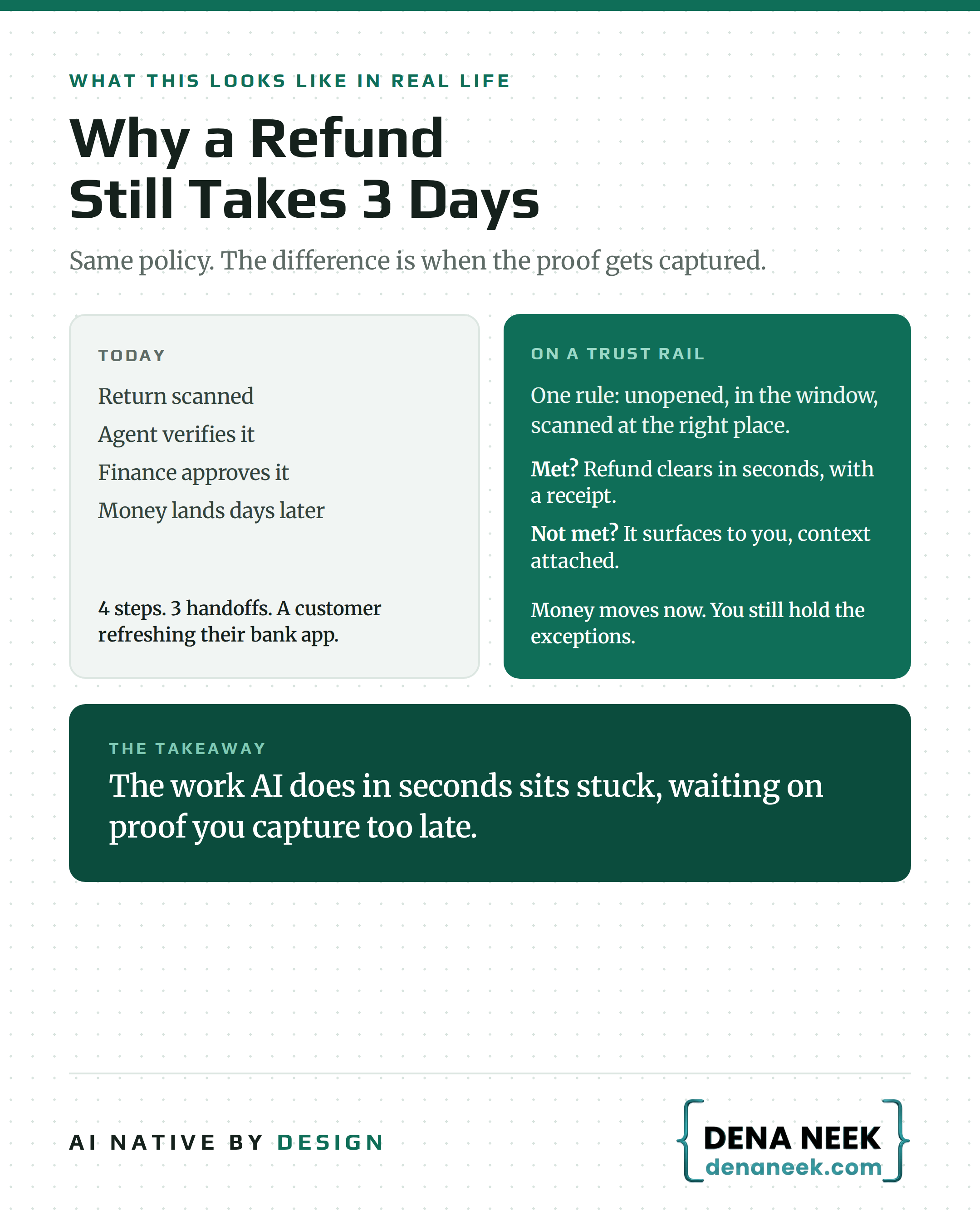
Watch where the three days actually go. The return gets scanned. An agent verifies it. Finance approves it. The money lands days later, while the customer refreshes their bank app wondering where it is.

Now run the same refund on a trust rail. One rule up front: unopened, returned in the window, scanned at the right place. Condition met, the refund clears in seconds with a receipt. Condition not met, it surfaces to a human with the full context already attached.

Same policy. Same rules. The only thing that changed is when the proof gets captured. Today you reconstruct it at every step. On a rail, it's captured once, at the moment it happens.

And the override rate tells you something nobody measures: if your team keeps overriding the rule, the rule is wrong. Now you can finally see it. What's one approval in your business that drags for days but is really just a yes-or-no condition?

Slow trust: the three-day refund
AI-Native LeaderOwn Your Trust Layer

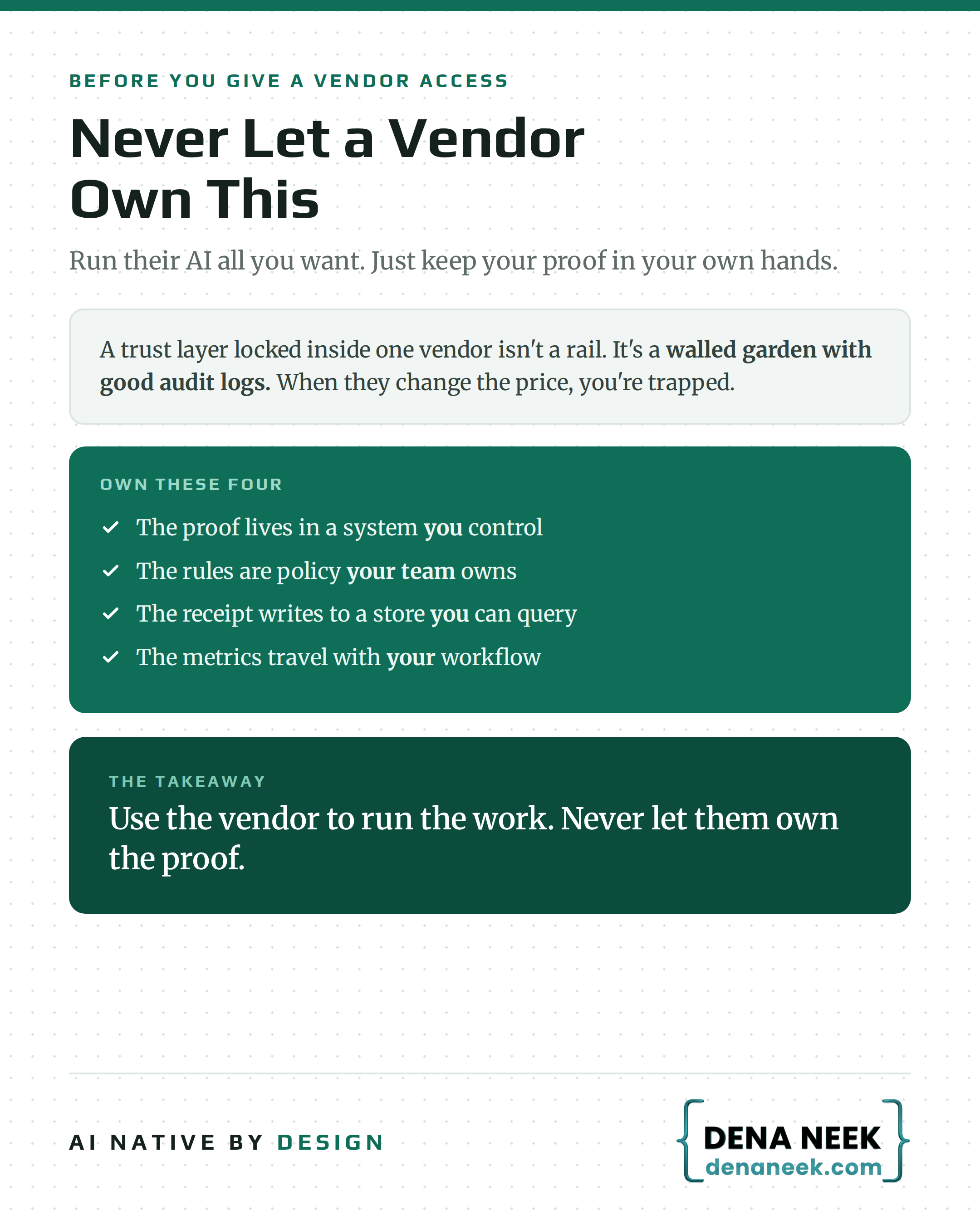
🔓 The day your AI vendor raises the price, you'll find out who really owns your business.

Here's the trap nobody mentions when you sign up.

Most AI platforms don't want your agents talking to anyone else's. Everything works beautifully inside their walls. Then the terms change, or the price doubles, and you realize your entire trust layer lives in their system, not yours.

A trust setup locked inside one vendor isn't a rail. It's a walled garden with good audit logs.

So before you give any vendor deep access, make sure you own four things: the proof lives in a system you control, the rules are policy your team owns, the receipt writes to a store you can query, and the metrics travel with your workflow.

Do that, and switching vendors is just an infrastructure change. Skip it, and you rebuild your trust layer every time they change their mind.

Use vendors to run the work. Never let them own the proof.

If your main AI vendor doubled their price tomorrow, would you still own everything they've been recording?

Use vendors to run the work. Never let them own the proof.
AI-Native LeaderEarned Autonomy

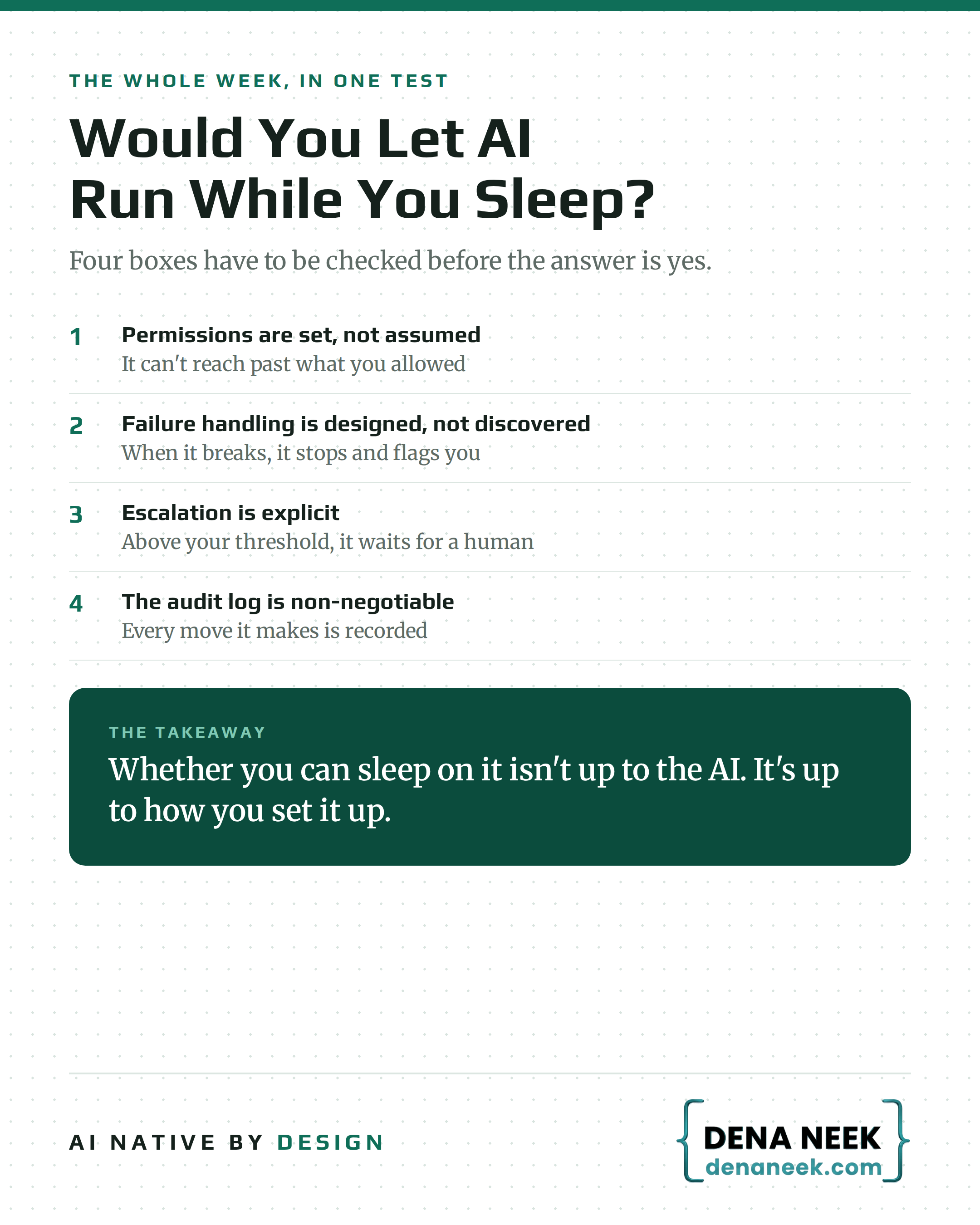
🌙 Would you let AI run your business while you sleep?

For most operators the gut answer is no. The honest answer is "it depends," and it depends on four things being true before the agent ever runs.

Permissions are set, not assumed. It knows exactly what it can read and write, and it can't reach past what you allowed.

Failure handling is designed, not discovered. When something breaks, it doesn't improvise. It stops, logs what it tried, and flags you.

Escalation is explicit. Above your threshold, it waits for a human. Approval is bound to the exact action, not a blanket yes.

The audit log is non-negotiable. Every move it makes is recorded.

Miss any one of these, and 3am autonomy isn't a system. It's a liability that works until it doesn't.

This is the whole week in one line: trust at machine speed isn't a feature of the AI. It's something you design. Which makes it your job, not your vendor's.

So, honestly: would you let it run tonight, and which of the four is missing?

Would you let AI run your business while you sleep?